Get Full Government Meeting Transcripts, Videos, & Alerts Forever!
Get email alerts on the Collective Bargaining topic
No spam. Unsubscribe anytime.
Mount Angel council splits over police pay; council later adopts 9% first-year increase in CBA
Summary
Council members debated competing offers for a police collective bargaining agreement — a staff-backed 9% first-year raise and a council-proposed 13.1% alternative — and after two failed motions the council returned later in the meeting and adopted Resolution 16-12 to implement a 9% first-year wage adjustment and authorize the city manager to execute the agreement.
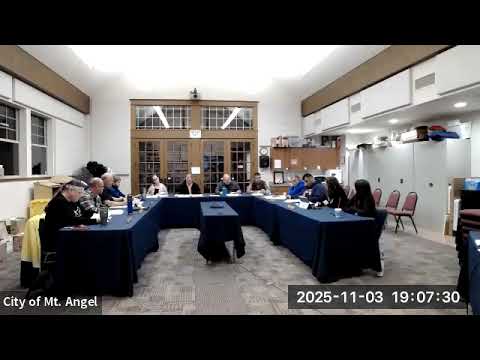
The Mount Angel City Council spent the Nov. 3 meeting debating a new collective bargaining agreement with the Mount Angel Police Association and ultimately adopted Resolution 16-12 to implement a 9% wage increase in the first year and authorize the city manager to execute the contract.
Council discussion centered on whether to accept a staff-tentative agreement that would provide a 9% first-year wage increase (with smaller increases in later years) or to press for a 13.1% first-year increase proposed by some council members. Staff described the tentative agreement’s structure — shifting many flat certification payments into grouped percentage-based certification pay, converting some on-call hours to compensatory time, and aligning certain holiday rules — and said most public works compensation changes would be funded from enterprise funds.
The council first voted on a motion to adopt Resolution 16-12 with the 9% first-year adjustment; the chair announced the vote as 4–3 against and the motion failed. A second motion to reenter negotiations and adopt a 13.1% first-year increase also failed on roll call (recorded in the minutes as four nays to three ayes). After moving the item to the end of the agenda the council revisited the issue and a subsequent motion to adopt Resolution 16-12 with a 9% wage adjustment in year one and authorize the city manager to execute the agreement was made and seconded; roll-call votes were recorded and the chair concluded the meeting after the final roll call.
Throughout debate council members and staff emphasized recruitment and retention concerns. The mayor noted the city’s small workforce and single points of failure in operations, saying the city swallows a substantial cost when it loses a trained employee; the mayor estimated a per-employee turnover training cost of about $61,800 (wages only). Councilors also discussed comparables with neighboring Silverton and expressed concern about equity across the workforce if police wages rose more than other departments. Finance staff and the city manager repeatedly stressed budget constraints and noted that some pay increases for public works staff are funded by enterprise funds rather than the general fund.
Opponents of the larger increase argued the city must weigh operational risks and ensure continuity across departments; supporters said higher pay was needed to keep officers from leaving and to avoid staffing gaps that would force the city to rely on county coverage. The transcript records repeated requests by councilors for clearer, condensed finance summaries to make trade-offs more visible in future budget decisions.
Next steps: the city manager was authorized to execute the adopted agreement per the motion language. The council moved other business and adjourned. The contract’s implementation schedule, effective dates and any administrative steps required to update payroll were discussed in staff materials but not exhaustively recorded in the public minutes.