Get Full Government Meeting Transcripts, Videos, & Alerts Forever!
Get email alerts on the Wastewater topic
No spam. Unsubscribe anytime.
Mount Angel council hears costly options to remove wastewater-lagoon sludge; consultant favors Coffin Butte disposal over land application
Summary
City engineers told the council the primary lagoon has sludge above design capacity and recommended hauling to Coffin Butte landfill rather than on-farm land application unless extensive stabilization and DEQ approval are completed; preliminary removal and dewatering was estimated at about $1.7 million with additional transport and tipping fees noted.
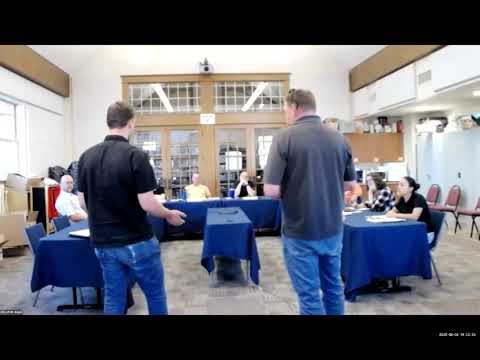
Mount Angel councilors spent most of the meeting on June 2 examining options to remove an accumulated mound of sewage sludge from the city's primary wastewater lagoon.
An environmental engineer who said they work for Civil West told the council the lagoon has exceeded its design storage and that primary (unstabilized) sludge contains ground plastics and other materials that make land application problematic. "I don't think that it's environmentally conscious necessarily to land apply it," the engineer said, noting that land application of primary sludge would require stabilization, intensive testing and explicit approval from the Oregon Department of Environmental Quality (DEQ).
The consultant outlined three basic options: targeted dredging of high mounds, full dredge with dewatering and transport to an external facility, or seeking farms willing to accept stabilized biosolids. For disposal in one season, the consultant said Coffin Butte is effectively the only single facility that could accept the full quantity in one programmatic push. "There's really only one option that can take it all in one go, which is Coffin Butte," the consultant said.
Councilors pressed for specifics. Participants discussed volumes and haul methods; the engineer described roughly 1,700 cubic yards of material in the lagoon and the implications for tanker or dump-truck logistics. On cost, the engineer said the removal and dewatering estimate was about $1.7 million; councilors in that same conversation referenced transport around $550,000 and a tipping-fee figure near $600,000.
The engineer described the DEQ process for land application: a signed site-authorization letter between a landowner and the city, a biosolids management plan, and intensive sampling for vector attraction, metals and pathogens. The consultant estimated the authorization and plan process, including DEQ review, could run roughly a year; regular sampling would be required each time sludge is dredged.
Councilors asked about interim or lower-cost approaches. The consultant said targeted dredging of the highest mounds to restore operating depth could reduce immediate costs and avoid a full-season program. The council also discussed longer-term capital fixes: adding inlet screening ahead of the lagoons to capture plastics and other debris would reduce future contamination but would create an ongoing stream of removed solids that also requires regular disposal.
Council president (the councilor who introduced the item) and other members asked about liability and operational methods; the engineer said liability for material transfers generally ends when the contractor follows the approved procedures and a load leaves a scale, but failures in contractor procedures could leave liability exposure. The consultant noted practices used in other cities (centrifuges or belt filter presses for dewatering) that can reduce haul volumes and per-load cost.
The council did not take a final action on contracting; instead members sought more detailed bids, cost breakdowns by hauling method and clarification on permit timelines so the council can decide whether to proceed with targeted dredging this season or plan for a larger procurement.
What happens next: staff said they will work toward a scope of work and invitation to bid, and the council discussed targeting a contractor in place by spring 2026 in a best-case schedule if the council directs staff to proceed.