Get Full Government Meeting Transcripts, Videos, & Alerts Forever!
Get email alerts on the Urban Growth Boundary topic
No spam. Unsubscribe anytime.
Molalla consultants say city needs about 182 acres to meet 20-year housing demand; residents raise water, annexation and growth concerns
Summary
Consultants at Molalla's first UGB meeting said the housing needs analysis shows a remaining need of roughly 928 housing units (about 182 acres) and urged parcel-level public feedback. Residents asked about water rights, annexation choices, infrastructure costs and developer pressure; staff outlined next steps and timelines.
Molalla held its first public meeting on expanding the city's urban growth boundary (UGB) on July 22, where city staff and consultant Violet Brown outlined the technical process for identifying land for the next 20 years of growth and invited residents to submit parcel-level comments.
The consulting team told attendees the city's Housing Needs Analysis (HNA) projects Molalla will add about 5,400 people by 2042, which the consultants translated into an initial need of roughly 1,996 housing units. After accounting for roughly 287 units already in the development pipeline and recent rezoning inside the UGB, Brown said the remaining need is about 928 units, which the team estimated would require approximately 182 acres of residential land outside the current boundary.
"We're looking down the road 20 years and trying to estimate how much the city is going to grow and do we have enough land," Brown said. She described the UGB as a planning tool to encourage development inside the boundary and protect agricultural and forest lands from sprawl.
The Economic Opportunities Analysis (EOA), adopted in February 2025, projects between about 860 and 1,730 jobs over 20 years and flagged a shortage of sufficiently large industrial parcels inside the UGB. Brown said the city needs several larger sites (20+ acres and multiple 10'0-acre sites) for some employer types, and that while there is acreage classified as industrial inside the UGB, many parcels are too small for larger employers.
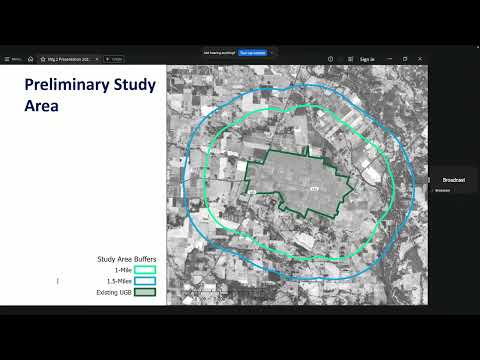
The consultant explained the technical steps used to draw the study area: a statutory buffer (generally 1 mile, sometimes 1.5), then statutory exclusions for rivers, steep slopes, wetlands, federal land and rural reserves, and mapping of soils (prime/unique/high-value farmland) and other constraints. She identified roughly 580 acres of "exception lands" (outside the UGB but already with urban uses) in the southern study area that the team is required to examine first under state rules.
Staff emphasized that inclusion in the UGB does not automatically change property taxes or force annexation. "Property owners are not required to annex into the city if the urban growth boundary expands to include their property," Matt Cortell, assistant city manager, said. He and Brown described subsequent steps after any expansion: master planning of the added area, then comp plan and zoning decisions, then infrastructure planning and, if necessary, annexation processes that include public notice and hearings.
Residents used the question-and-answer portion to press staff on several practical issues. Laurie Freeman asked whether Molalla's water rights would support growth. Cortell said the city currently holds just over 4,000,000 gallons per day of water rights and that peak summer draw is about 1,300,000 gpd, adding that the consultants and staff expect residential growth to remain within those rights but that large industrial users would require individual, engineered water-demand analyses.
Several attendees sought clarity on infrastructure timing and cost. Staff said the city is constructing an upgraded wastewater treatment plant and that major infrastructure is sized to projected growth; staff estimated that, under an accelerated scenario and assuming necessary zoning and master planning, a large industrial project could take roughly 2.5' years from UGB expansion to initial construction if an applicant quickly completed master plans and permit processes.
Other commenters raised concerns about taxes, quality of life and developer pressure. One attendee warned that allowing more acreage into the UGB could invite outside developers and accelerate conversion of agricultural land. Brown and Cortell said that state planning rules require cities to prepare to accommodate projected population change and that the HNA and EOA provide data-driven constraints (including assumptions about housing types and densities) that inform zoning and comp plan amendments.
The team encouraged property owners and farmers to provide parcel-specific information (crop types, deed restrictions, evidence of developability) using the comment form provided at the meeting or the identical online form (QR code on the handout). Brown said the online survey will be open for two weeks; staff will read paper responses and include them in the May briefings to the planning commission and subsequent city council work sessions. The project team expects the planning process and final city recommendation to continue through March 2026, followed by required county and state reviews.
What comes next: staff and the consultant will incorporate public comments and refine parcel-level capacity analyses, present preliminary findings to the planning commission and city council in May (work sessions, not decisions), and continue consultations with technical and public advisory committees. Materials and reports (HNA, EOA, maps) are posted on the project website, Molalla Current, and the city asked residents to sign in or subscribe for email updates.
Speakers quoted in this article are those identified during the meeting. If you attended and have parcel-specific information about soils, deed restrictions, wetlands or existing uses, the team asked that you submit it on the provided form to ensure it is considered in the technical analysis.