Get Full Government Meeting Transcripts, Videos, & Alerts Forever!
Get email alerts on the Septic Variance topic
No spam. Unsubscribe anytime.
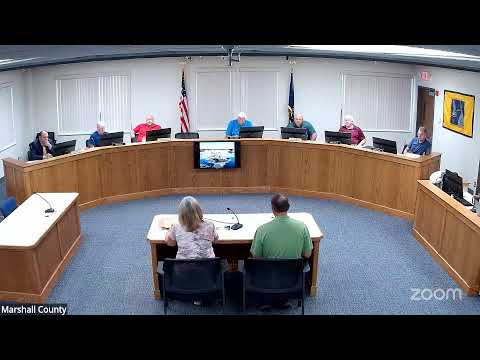
Drainage board approves septic setback variance for Dennis Court with owner responsibility caveat
Summary
The Marshall County Drainage Board approved a variance allowing an AES septic system to be installed as close as 16 feet to a county-regulated drain at 10711 Dennis Court, provided the designer first explores rotating the system to increase setbacks; the property owner will assume financial responsibility for future repairs if county work is required.
The Marshall County Drainage Board on July 20 approved a variance for a proposed AES septic system at 10711 Dennis Court, allowing the installation to be placed as close as 16 feet from a county-regulated drain if the owner chooses that configuration.
Board members were briefed that the property includes two lots (house on one, a vacant lot beside it) and that the new septic line would cross a county-maintained 'buck tile' drain and sit within the maintenance easement. The project's preparer provided calculations and the board was told the proposed drainage controls would not increase peak discharge to the county system.
Homeowner Stasha Gomez told the board the existing system has failed and intermittently backs up into her house, and the designer recommended the AES/mound system as the solution. County presenter (S3) said the closest part of the proposed system would be about 16 feet from the maintenance easement and recommended the drain crossing use gasketed pipe to reduce risk of leakage into the county system.
Board members pressed the applicant to explore whether the system could be rotated 90 degrees to create a longer, narrower footprint and increase the setback to the board's preferred 20 feet. Several members also asked whether local yard-setbacks or health-department rules limited how far the system could be moved. The Marshall County Health Department had conducted soil sampling and recommended the AES system for the site's soil conditions, per the owner.
Committee member S8 moved to approve the variance contingent on two conditions: that the designer be asked to evaluate rotating the system to maximize setbacks, and that if the owner proceeds with a setback as small as 16 feet, the property owner assumes financial responsibility for any future repairs to the septic line or county work that may be required. S5 seconded the motion. Chair S2 called for the voice vote; the motion carried.
The board and staff said the design and any required permits (including the county 'cross a regulated drain' application) must be completed before field work begins. Staff (S3) will follow up with the applicant and preparer about possible design changes and notify the board of updates.
The board did not authorize county-funded repairs should the system fail at the reduced setback; the approval records that the county is not responsible for owner‑installed work inside the maintenance easement when the owner accepts the reduced setback.