Get Full Government Meeting Transcripts, Videos, & Alerts Forever!
Get email alerts on the Csw Overview topic
No spam. Unsubscribe anytime.
Presenter explains Kansas Community Support Waiver: $20,000 annual budget and 500‑person cap
Summary
A KDADS training video explains the new Community Support Waiver (CSW) for Kansans with intellectual or developmental disabilities: eligibility rules, a $20,000-per-person annual cap, a 500‑participant enrollment cap and priority for people on the IDD waiver wait list. The video outlines available services and self‑direction responsibilities.
The presenter in a Kansas Department for Aging and Disability Services (KDADS) training video outlined the new Community Support Waiver (CSW), describing who is eligible, how enrollment will work and the services participants may use. "The CSW provides a per person annual budget of up to $20,000," the presenter said, and the training notes that "Only legislative action can adjust this limit."
The video explains eligibility: CSW participants must be Kansas residents, at least 5 years old, have an intellectual disability with onset before age 18 or a developmental disability with onset before age 22, meet KDADS program eligibility and the Medicaid long‑term care institutional threshold, and be financially eligible for Medicaid through the Kansas Department of Health and Environment (KDHE). Annual eligibility reassessments are required.
KDADS told viewers the waiver is capped at 500 participants and that the CSW "does not have a wait list." The presenter said that if capacity is reached, KDADS will not process new applications until slots are available and that KDADS will communicate capacity status with community developmental disability organizations (CDDOs). The training also explains priority enrollment for people already on the IDD waiver wait list: applicants who have been on that wait list the longest will be selected for CSW entrance before others, and those who enroll in the CSW will lose their spot on the IDD waiver wait list.
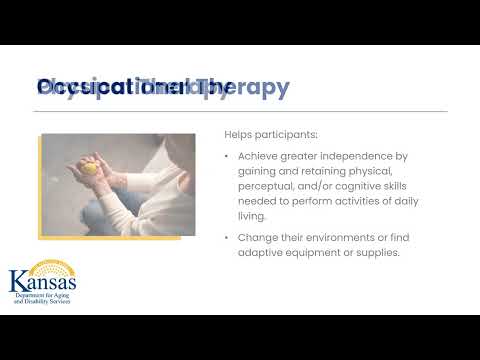
The video lists 21 services available under the CSW, including individual employment support (IES), personal care services (PCS), respite, behavior therapy, occupational and physical therapy, speech and language therapy, assistive technology, benefits planning, career exploration, family and caregiver support and training, home and environmental modification services (HEMS), home telehealth, individual directed goods and services (IDGS), life skill services, medication reminder services, nonmedical transportation (NMT), personal emergency response systems (PERS), remote support services, specialized medical equipment and supplies (SMES), and vehicle modification services.
KDADS highlighted which services may be self‑directed: personal care services, respite, nonmedical transportation, family/caregiver support and training, and IDGS. The presenter outlined participant responsibilities when self‑directing (recruiting and supervising workers, setting wages within state ranges where applicable, completing background checks and timesheets, and approving staff duties) and explained the role of financial management services (FMS) agencies in payroll, tax withholding and budget reporting. Targeted case managers (TCMs) and managed care organization (MCO) care coordinators are described as assisting participants with budgeting and service planning.
The training explains that some services may be delivered virtually under KDADS' Virtual Delivery of Services (VDS) policy when agreed in the person‑centered service plan and not solely for provider convenience. KDADS also describes procurement practices: MCO care coordinators request bids for some services and are instructed not to accept bids based solely on cost.
The presenter used fictional examples (Riley, Austin, Lawrence, Lupe, Daniel) to illustrate how family caregiving, current wait‑list status and service needs factor into the decision to enroll in the CSW or remain on the IDD waiver wait list. Viewers are repeatedly advised to consult their local CDDO to assess eligibility and make an informed choice.
The training video closes by reiterating that the CSW is designed for Kansans with intellectual or developmental disabilities who do not need continuous 24‑hour paid support, and that it "provides a per person annual budget of $20,000" while recognizing the waiver "is not a good fit for all people who might be eligible." Prospective applicants are instructed to contact their CDDO for an eligibility assessment and next steps.