Get Full Government Meeting Transcripts, Videos, & Alerts Forever!
Get email alerts on the Transportation topic
No spam. Unsubscribe anytime.
Fairfax County staff outline speed-hump plan for Middle Run Drive; 33 of 65 ballots needed to pass
Summary
Fairfax County Department of Transportation presented a proposed speed hump for Middle Run Drive, explained eligibility and balloting (65 ballots in area; at least 33 yes votes required), and answered resident questions on e-bikes, drainage, snow removal and lighting. If the ballot passes, the county will seek Board endorsement and VDOT approval before installation.
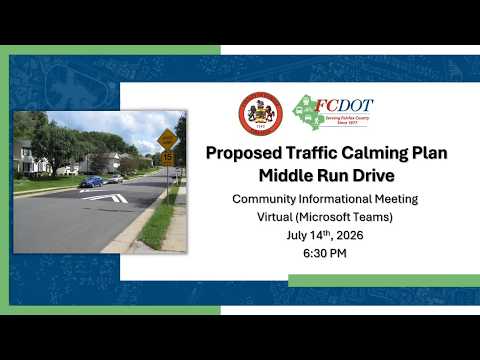
Fairfax County Department of Transportation staff on Monday presented a traffic-calming proposal for Middle Run Drive that would add a single speed hump and requires a community ballot before installation. FCDOT staff said the road met county eligibility standards after a traffic study and that the ballot area contains 65 occupied properties, meaning the plan would need at least 33 yes votes to proceed.
The proposal was presented by Nicole Michaquay of FCDOT, who described traffic calming as ‘‘the installation of physical devices to reduce vehicle speed,’’ and outlined a five-step process that ends with installation only after a successful community ballot and endorsement from the Board of Supervisors. Michaquay said the county’s study found Middle Run Drive carried 694 vehicles in a 24-hour period and that the eastbound 85th-percentile speed was 35 mph, exceeding the county’s speed threshold for consideration.
Under the plan FCDOT shared, the recommended device is a speed hump 12 feet long and about 3 inches high at center, marked with white chevrons and signs advising a 15 mph crossing speed. Michaquay said property owners directly adjacent to a proposed device must sign off on placement; all occupied properties in the ballot area will receive one vote and ballots must be returned directly to the district supervisor’s office (mail, hand-delivery or email). ‘‘The ballot period will be open for a minimum of three weeks,’’ she said.
Residents raised safety and operational concerns during the question-and-answer session. A task-force lead, Viviana Reyes, asked whether ballots arrive preprinted; staff answered that FCDOT provides a ballot template and cover letter and that ‘‘the task force will need to then print out the ballot’’ for distribution. Several residents asked whether a property on a pipestem driveway counts as an adjacent property required to sign off; staff clarified such a lot would generally be inside the ballot area and receive a vote but would not be treated as an ‘‘adjacent property’’ that must sign off on device placement.
On questions about snow removal, drainage and manholes, staff said the Virginia Department of Transportation (VDOT), which maintains Middle Run Drive, will not allow a device that impedes snow clearance and that the humps are designed not to extend into the gutter pan so drainage and manholes should be unaffected. On e-bikes, resident Jeff Cardison asked whether small electric bicycles would be hindered; staff said speed humps slow vehicles to about 15 mph ‘‘so unless you’re running your e-bikes well above 15 miles per hour, then you’re going to have to slow down’’ but added smaller e-bikes may be able to use roadway edges depending on width.
Michaquay said if the ballot achieves the necessary yes votes, FCDOT would bring the plan to the Fairfax County Board of Supervisors for endorsement and send a resolution to VDOT; installation would follow coordination with the Department of Public Works and Environmental Services. Staff estimated that, weather permitting and assuming asphalt availability, a successful ballot would likely lead to Board consideration in roughly a month and installation in two to three months after that — a total of about three to five months from ballot passage.
Residents were told FCDOT can perform a follow-up speed count about six months after installation if requested through the supervisor’s office. Staff closed by posting contact information for DOTinfo@FairfaxCounty.gov and the Springfield District office and thanked participants. The task force must decide whether to move to the ballot phase and notify the supervisor’s office to begin that process.