Get Full Government Meeting Transcripts, Videos, & Alerts Forever!
Get email alerts on the Urban Renewal topic
No spam. Unsubscribe anytime.
City attorney briefs council on how urban renewal and tax-increment financing work
Summary
City attorney Missy led a 101 briefing explaining urban renewal agencies, plans and tax-increment financing, answering council questions about blight findings, multiple districts, extraterritorial land and statutory caps on acreage and indebtedness.
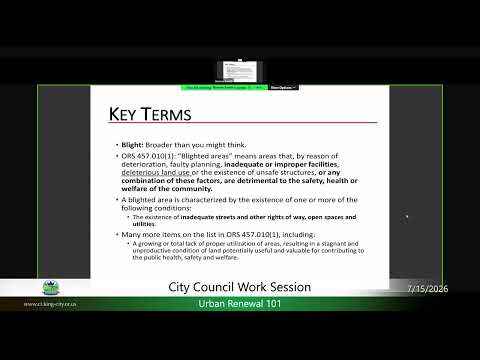
Missy, King City's city attorney, gave a step-by-step briefing on urban renewal at the council's July 15 meeting, explaining that an urban renewal agency (URA) is a legally separate entity governed by ORS chapter 457 and created to fund projects that address defined "blight" through tax-increment financing. She told the council the URA has its own governing body, budget and power to acquire and convey property in its own name.
Missy said a URA plan establishes boundaries, projects and a maximum indebtedness figure; the plan must make findings that the area is blighted, conform with the comprehensive plan and follow the notice and public-hearing procedures set out in state law. She described the taxing-district review process (45 days for written recommendations) and noted that certain public-building projects require concurrence of a majority of the most-impacted taxing districts.
On financing, Missy explained the basic TIF mechanism: when a plan is adopted the assessed value in the URA is "frozen," and tax revenues generated above that frozen base (the increment) are used to repay URA debt or fund projects. Because the increment takes time to accrue, she said agencies typically borrow early and repay from the increment as improvements raise assessed value.
Council members and others asked practical questions. Missy said a municipality that activates its URA can create multiple separate URA districts at different times, but no parcel may belong to more than one district and the city must respect statutory acreage and indebtedness caps. She said extraterritorial inclusion is possible but requires consent of other jurisdictions (for example, county consent). When asked if "blight" declarations are equivalent to eminent domain, she said they are not; declaring blight enables use of TIF, loans and other tools but does not itself equate to condemnation authority.
Missy recommended that a city considering a URA conduct a feasibility study with a consultant to estimate likely increments and to help determine whether the benefits justify the administrative and planning work required. She said slides from the presentation will be emailed to council and added to the packet as an addendum.
The training is intended as foundational information for council deliberations about whether to pursue an activated URA for areas of King City.