Get Full Government Meeting Transcripts, Videos, & Alerts Forever!
Get email alerts on the Fairgrounds Arena topic
No spam. Unsubscribe anytime.
County hears plan for 3,000-seat covered equestrian arena, consultant cites $5.9 million annual economic impact
Summary
Consultants presented a scaled proposal for a 3,000-seat covered equestrian arena at the Washington County fairgrounds, projecting about $5.9 million in annual direct and indirect spending at stabilization and $620,000 in annual tax revenue across taxing entities; commissioners discussed phasing, funding options and multiuse design trade-offs.
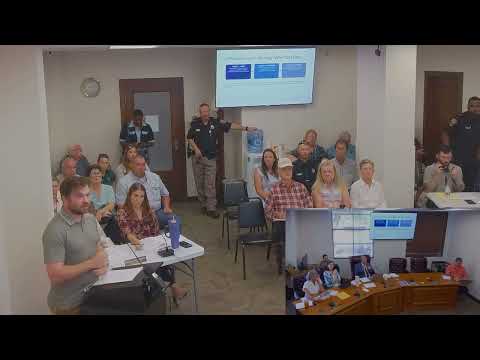
Consultants and county staff on Tuesday outlined a phased plan for a covered, equestrian-focused arena at the Washington County fairgrounds, saying the project could generate new economic activity while leaving room to expand in later phases.
The presenter, identified in the record as Harrison, told the court the immediate proposal is for a 3,000-seat, 150-stall open-air arena that could be expanded later toward the 5,000-seat, 300-stall layout recommended in an earlier 2024 study. “It is time to expand,” Harrison said, adding the design is intended to “separate out the bunk beds” — an analogy for making space for both equine and cattle uses as the facility grows.
Why it matters: the consultant said the arena, once stabilized in year three or four, would support about $5.9 million in annual direct and ripple spending in the regional economy and could generate roughly $620,000 a year in new tax revenue across state, city and county taxing entities — with most of that revenue accruing to the state and city rather than county coffers. The presentation estimated the split at about $398,000 to the state, $220,000 to the city of Brenham and roughly $2,000 to the county in a stabilized year.
Court members pressed the team on practical trade-offs. Commissioners and staff discussed the decision to start smaller — 150 stalls versus the study’s 300 — as a way to phase cost and reduce initial financial risk. Harrison said starting with the smaller configuration allows the county to “design your facility to grow” and phase future additions as revenue and bookings increase.
The consultant also described operational revenue streams the county could capture that public events currently do not: stall fees, sale of bedding shavings, and expanded concessions. He projected roughly $101,000 in the arena’s first year from these and other direct revenues, with growth toward stabilization in subsequent years.
Funding and design questions: the presentation reviewed naming-rights and multi-year contribution models used by comparable rural venues and emphasized that the proposed arena would not be air-conditioned; design choices were described as driven by cost, local market fit and equestrian operating needs. Commissioners highlighted the opportunity to unlock Barn 3 for cattle uses when the new arena opens, which could multiply the venue’s utility and revenue potential.
Next steps: staff said they will provide additional materials to the court in the coming weeks. The record shows commissioners thanked the presenters and indicated further review and planning work will continue before any final commitment.