Get Full Government Meeting Transcripts, Videos, & Alerts Forever!
Get email alerts on the Self Direction topic
No spam. Unsubscribe anytime.
KDADS says self-direction on CSW will be limited at launch to five services; explains IDGS, FMS and broker roles
Summary
KDADS reported Cadence will initially allow self-direction for five CSW services (personal care, respite, nonmedical transportation, family caregiver support/training and IDGS), clarified FMS and support-broker arrangements, raised provider-network constraints for other services, and increased the notice period to stop self-direction from 10 to 30 days.
KDADS presenters told attendees at the final Community Support Waiver town hall that self-direction will be limited at launch to five services and explained how that approach will work operationally.
“Cadence has decided to limit self direction to five services on the CSW, just initially,” Jackie Merriweather said. The five services named were personal care services, respite, nonmedical transportation, family caregiver support and training, and individual directed goods and services (IDGS).
Jackie explained Cadence’s rationale: for several newly added or unbundled services (assistive technology, remote supports, career exploration and planning, individual employment-support services, benefits planning and life skills), KDADS and Cadence want managed care organization (MCO) provider networks to be established before allowing self-direction for those services. For certain medically specialized services — for example behavior therapy and physical, occupational and speech therapy — Jackie said required provider qualifications make self-direction impractical at launch and those services will be provided only through agencies contracted with MCOs or via subcontracting arrangements (for example through Centers for Independent Living).
KDADS clarified operational roles and payments. Jackie said support brokers will help participants who self-direct to develop spending plans, hire staff and set wages; she said support brokers will be employed by the state‑contracted financial-management services (FMS) provider. Michelle added that FMS and support-broker payments will be paid by Cadence as administrative funds and “will not come out of” a participant’s $20,000 annual budget cap.
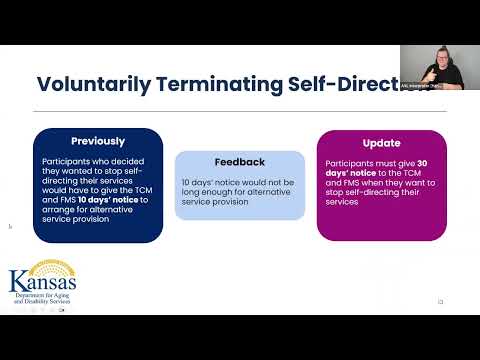
The agency also adjusted a procedural detail after stakeholder feedback: KDADS changed the draft waiver to require 30 days’ notice — rather than 10 days — when a participant wants to stop self-directing services, to give time to arrange alternative service provision.
On what IDGS can cover, Jackie said approvals will be tied to an assessed need and service‑plan goals: IDGS can pay for goods or services not available through other waiver services, but cannot duplicate items available through DME or other existing codes. She gave examples used in other states — a microwave to support independent meal preparation, equine therapy or a summer camp tied to a plan — and cautioned that approvals will depend on the participant’s assessed needs.
KDADS encouraged attendees to review the CSW service definitions and rate tables on the website and to submit comments during the formal public comment period.