Get Full Government Meeting Transcripts, Videos, & Alerts Forever!
Get email alerts on the Community Support Waiver topic
No spam. Unsubscribe anytime.
KDADS details changes to Community Support Waiver after 91 public comments; submits waiver to CMS
Summary
Kansas Department for Aging & Disability Services and Hospitals (KDADS) said it revised multiple waiver appendices after 91 public comment submissions, clarified enrollment safeguards, service definitions and provider requirements, and has submitted the waiver to CMS with a tentative Oct. 1, 2026 enrollment date.
Michelle Hayden, the long-term services and supports commissioner for the Department for Aging & Disability Services and Hospitals, told a Feb. town-hall that the agency and its contractor summarized 91 public-comment submissions and edited waiver language where comments led to clarifications.
KDADS said the comments prompted language updates in appendices B, C, E, G and I of the Community Support Waiver (CSW). "We reviewed all the comments and then based upon the comments received, updated the following appendices, B, C, E, G, and I," Hayden said. The agency directed attendees to kansascsw.com for a full comment-and-response record and the updated waiver text.
KDADS staff said the edits were mostly clarifications rather than substantive policy shifts, though a few changes alter delivery settings or provider requirements. Elian Sorensen, who led the presentation of updates, said the agency added a requirement in Appendix B(6)(f) that CDDOs must inform applicants about the CSW service limit and sign an acknowledgement prior to enrollment. "CDDOs will have the individual or their representative sign to show that they received this information prior to enrolling on the CSW," Sorensen said.
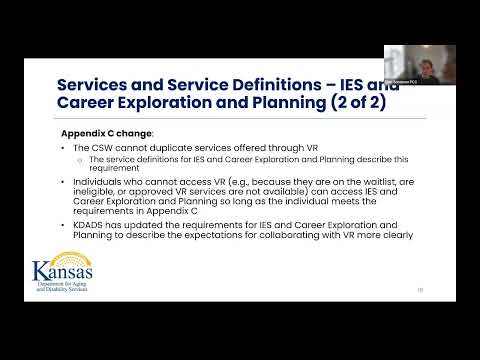
The agency also clarified how CSW services interact with state vocational rehabilitation (VR) services and Medicaid state-plan services. KDADS explained that CSW services "cannot duplicate services offered through VR," but added text to Appendix C to describe when people on VR wait lists or found ineligible for VR may nevertheless access CSW employment services until VR becomes available. KDADS added a sentence in each relevant service limitation stating participants must exhaust Medicaid state-plan services before CSW funds can be used for services available under both systems.
KDADS said it revised the individual employment support (IES) service definition to clarify payment practice so that rates are based on hours the participant works rather than provider hours. The agency also updated the assistive-technology consultation language to require MCOs to request appropriate in-home or remote assessments and to document recommendations from an assistive-technology consultant; the consultant’s qualifications are in the provider-specification section.
One substantive change the agency described allows life-skills services to be delivered in a participant’s home in addition to community or provider locations. KDADS also removed a prior training requirement for occupational therapists, physical therapists and speech-language pathologists that would have required them to take training on restraint and crisis intervention.
On provider readiness, KDADS said it is developing a provider-readiness workgroup and training resources for CDDOs, MCOs and providers. Cadence, KDADS’s contractor, adjusted the list of services requiring electronic visit verification (EVV) to include behavior therapy, occupational therapy, personal care services, physical therapy, respite and speech-language therapy, and to remove home telehealth, medication reminders, personal emergency response systems and remote support services from the EVV list.
KDADS stated it has submitted the waiver to the Centers for Medicare & Medicaid Services and described the expected federal review steps — a 15-day call followed by requests for additional information if necessary — and said the agency is "confident" it followed applicable rules. Staff said a tentative start date for enrollment, if CMS approves, would be Oct. 1, 2026. The agency posted an email (KansasCSW@pcgus.com) and kansascsw.com for follow-up information and the full comment summaries.
The town hall included a Q&A where KDADS addressed questions about FMS enrollment for family members who wish to provide services, targeted case management (TCM) requirements, conflict-free case management, provider capacity and reserve capacity for people transitioning out of institutional stays. KDADS said TCMs will likely be required to serve people on the CSW and that TCMs must be conflict-free for that participant. The agency said it will publish more detailed policies and trainings and invited stakeholders to review the full summaries online.
KDADS emphasized several limits remain set by the legislature — most notably the CSW’s $20,000 annual service limit — and encouraged stakeholders to engage their legislators on funding or statutory changes. The agency said budget appropriations determine the number of enrollment slots and that some issues raised in comments (for example, expansions that require more state funding) are contingent on legislative action.
The town hall recording and presentation materials will be posted on the Kansas CSW website.