Get Full Government Meeting Transcripts, Videos, & Alerts Forever!
Get email alerts on the Waste Management topic
No spam. Unsubscribe anytime.
Southbury waste advisory panel keeps $17,000 phase‑1 cap for DEEP grant and eyes short LPR test at transfer station
Summary
The Southbury Waste Advisory Committee told prospective contractors they must show what they can deliver for the $17,000 DEEP‑approved phase‑1 budget and discussed asking the police chief for a short license‑plate‑reader trial to measure out‑of‑town use at the transfer station.
The Southbury Waste Advisory Committee agreed that proposals submitted in response to the town’s RFP must show what can be done for the $17,000 DEEP‑approved phase‑1 amount, and members discussed a limited trial of a license‑plate reader (LPR) at the transfer station to estimate nonresident and commercial use.
The committee meeting began with a procedural motion to approve the prior meeting minutes, which was moved and seconded with no objections recorded. Chair Chuck Liddy then reviewed the RFP posting and the committee’s plan to post a public Q&A document; he said the deadline for responses is July 29 and that the town will post submitted questions and the committee’s answers on the website.
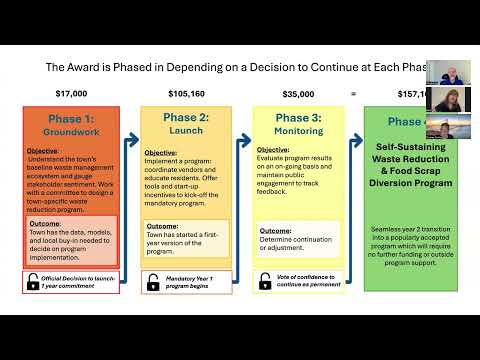
Members spent substantial time on the DEEP grant structure and budgets described in the proposal, noting line items that list $17,000 for phase 1, $105,000 for phase 2, an item listed as $160,000, and $35,000 for phase 3. The committee described phase 1 activities as baseline work: waste audits, outreach, public forums and design/pricing for program options. “Give us what you what you’re gonna do for that $17,000,” one committee member said, urging proposers to stick to the DEEP‑approved figure so the town can compare bids on the same basis.
On the question of moving money between phases, members said such a change would require DEEP approval and warned that shifting funds from later phases into phase 1 could create an expectation that the town proceed to phases 2 and 3. Committee members recommended a nuanced public answer: the town can move monies within the same DEEP category but would need to obtain DEEP’s approval for inter‑phase reallocations.
The discussion then turned to monitoring transfer‑station use. Members flagged long‑standing concerns that nonresidents and commercial vehicles dump at the facility and noted that an audit or electronic monitoring could clarify who is using the site. One participant suggested a short, confidential LPR trial arranged through Chief Grillo to provide a percentage estimate of out‑of‑town users without publicly releasing plates. “All you have to do is give us a number. Out of 100%, 20% are out‑of‑towners. That’s all we need,” a member said when describing the kind of nonidentifiable reporting the committee is seeking.
Members compared LPRs with so‑called Flock cameras and discussed procurement options: purchase versus subscription, vendor data ownership, local storage, and IT support. Several members emphasized that subscription models can be more expensive over time but may reduce upfront configuration and maintenance burdens; others warned that third‑party firms may retain data and that the town should consider local storage and IT capacity before proceeding. The committee agreed to involve Public Works, the police chief and the town IT staff in follow‑up conversations before any trial or procurement.
As next steps, the committee asked members to draft their top five ideas to guide research and proposed narrowing the RFP scope so a $17,000 contract can produce usable, focused recommendations. A volunteer offered to gather additional information and contacts to inform the group. The committee also agreed to prepare a short communication plan and to approach Public Works and the transfer‑station director through the proper chain of command after the group refines its questions.
The meeting closed with members agreeing to post the Q&A, finalize language that emphasizes the $17,000 phase‑1 requirement, and return with prioritized ideas at the next meeting.