Get Full Government Meeting Transcripts, Videos, & Alerts Forever!
Get email alerts on the Election Consolidation topic
No spam. Unsubscribe anytime.
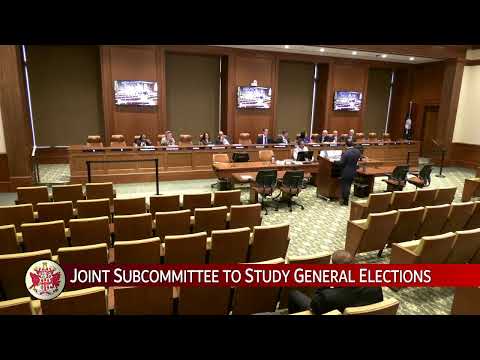
Virginia subcommittee adopts longer constitutional draft as vehicle to move elections to even years
Summary
A joint Senate subcommittee chose the longer constitutional-drafting option as its preferred vehicle to consolidate Virginia elections into even-numbered years, after debate over whether to bake local-office schedules into the constitution or handle them by statute. The committee set an Aug. 3 meeting to finalize policy choices.
The Senate joint subcommittee on election consolidation voted to adopt the longer version of a proposed constitutional amendment as the committee's vehicle to move Virginia elections to even-numbered years.
The chair opened the meeting on July 22 to review two drafts Brooks had prepared: a longer draft that places transition details in the constitution and a shorter draft that provides only enabling constitutional language and relies on statute for most implementation. "The longer option...put[s] the details of the transition in the constitution and allow[s] the people to decide on those details when this goes before voters," Brooks said during his presentation.
Committee members focused on two central trade-offs. Supporters of the longer draft said it gives voters clarity about how offices would transition and reduces uncertainty about local schedules. "If we're trying to make a clear case to voters on this question, having as many decisions made in advance is probably important," Doug McPike said. Opponents and cautious members said the shorter approach gives the General Assembly more flexibility to fine-tune schedules by statute and avoid "locking in" short-lived transition language in the constitution.
Brooks described concrete options in the longer draft, including aligning elections to "the Tuesday after the first Monday in November," and using one-time transitional term adjustments (for example, three- or five-year transitional terms) to move constitutional and local offices onto even-year cycles. He also flagged complexities for local offices and clerks, whose current election cycles differ across localities, and noted the schedule language in the constitution's "schedule" section would be temporary. For the shorter draft, Brooks said the constitution would give the General Assembly authority to shorten or lengthen terms by one year for the purpose of adjusting cycles and could include an expiration date for that authority (he cited an example expiration of 2041).
Members also asked whether enactment of enabling statutes would require the governor's signature. Brooks replied that while a ratified constitutional amendment would take effect as approved by voters, any implementing statutes would still require the normal legislative process and gubernatorial action.
After discussion, a committee member moved to adopt the longer draft as the vehicle for further work on the amendment. The chair called a voice vote and announced, "Ayes have it," adopting the longer version (draft 2727100075d) as the committee's vehicle. The committee did not take a recorded roll-call tally in the transcript; the chair said Aug. 3 will be used to debate specifics (such as whether to shorten or lengthen particular terms and whether to excise or include local offices) and to seek a committee endorsement.
The chair opened the public-comment period and received no speakers. The meeting was adjourned.
Next steps: the committee will reconvene on Aug. 3 to deliberate the policy choices embedded in the chosen vehicle and to consider whether the committee will formally endorse a particular constitutional amendment draft.