Get Full Government Meeting Transcripts, Videos, & Alerts Forever!
Get email alerts on the Economic Development topic
No spam. Unsubscribe anytime.
Economic analysis: Hubbard lacks industrial land; consultant recommends strategy mix and outreach
Summary
A consultant-led economic opportunities analysis found Hubbard will likely need roughly 27–45 acres of industrial land (depending on forecasting approach) and several acres of commercial land over 20 years, and recommended infill, rezoning, code cleanups and targeted outreach, plus pursuing grant funding to update the comprehensive plan.
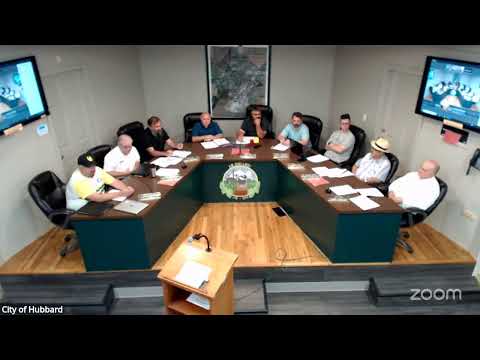
At a June 17 joint work session, consultant Jerry Johnson of Johnson Economics told the Hubbard Planning Commission and City Council that the city lacks large industrial sites and faces a multi‑decade shortfall in employment land unless it takes action.
Johnson presented three scenarios. Under the state’s safe‑harbor approach the city would need about 27.4 net acres of industrial land and roughly 7.1 acres of commercial; under the commission’s recommended scenario demand rises to about 44.6 acres of industrial and 16.6 acres of commercial over a 20‑year horizon. Johnson said the city’s current inventory includes roughly 10 acres of industrial and 7.7 acres of commercial identified as available in the county inventory, leaving a notable deficit for larger industrial users.
Holly Byram, the contract city planner, told the group: "You have nothing available over 5 acres" for true industrial development in the mapped inventory, and noted many mapped sites are in current outdoor use or are not readily developable. Johnson recommended a menu of approaches—encouraging infill and adaptive reuse, rezoning or code changes, targeted land assembly or incentives, and, as a last resort, expansion of the urban growth boundary—while cautioning the city that more aggressive growth forecasts can increase the risk of appeals under state law.
Officials discussed specific parcels (railroad-adjacent lots and parcels along Industrial Avenue) and soil constraints; commissioners emphasized protecting high-value soils when considering industrial expansion. City staff said the EOA is the first step: update the comprehensive plan economic element and BLI, then identify targeted implementation measures. Administrator Wade said budget constraints removed comprehensive-plan funding for FY26 and that staff "will be working with the COG to hopefully apply for a grant through DLCD" to fund the update and next steps.
The commission agreed to continue the conversation, with additional outreach and a planning commission hearing expected as the city moves from analysis to legislative or regulatory follow-up.