Get Full Government Meeting Transcripts, Videos, & Alerts Forever!
Get email alerts on the Sanctuary City topic
No spam. Unsubscribe anytime.
Hood River council authorizes emergency declaration after residents press for 'sanctuary city' action
Summary
After more than an hour of public testimony about recent ICE enforcement, Hood River’s city council authorized the city manager to declare a state of emergency and directed staff to draft options — including a sanctuary-city resolution, ordinances, outreach, and rapid-response supports — for a future meeting.
Hundreds of residents and multiple civic leaders urged the Hood River City Council on Dec. 8 to respond to local immigration-enforcement activity with stronger protections and clearer guidance for residents.
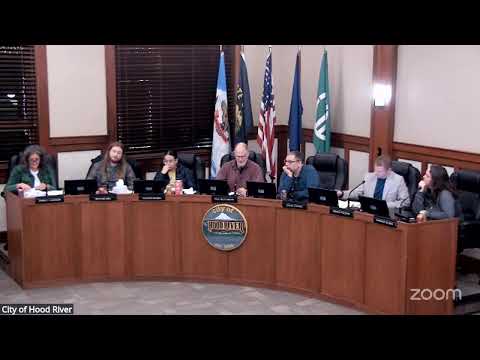
Mayor Paul Blackburn opened the packed meeting and, after a lengthy public-comment period in which speakers described fear, absenteeism at local schools, lost business for Spanish-speaking merchants and first-hand accounts of detentions, the council heard a policy briefing from City Manager Abigail Elder and legal remarks from City Attorney Dan Kearns and District Attorney Matt Ellis. Elder reviewed a menu of options other Oregon cities have used — emergency declarations, resolutions, and ordinances — and outlined outreach steps such as listening sessions, rapid-response training and incident-response funding for community partners.
The legal briefing stressed limits on local power. Kearns said federal agents are generally not subject to local control and warned the council against actions likely to provoke direct confrontation with federal law enforcement. Ellis, the district attorney, said his office will pursue criminal charges when the facts and evidence support them, but noted practical challenges when federal immunity or absence of identifying information complicates prosecution.
Councilors then debated the merits and legal risks of several approaches: an emergency declaration (which can accelerate procurement and allow short-term funding for community partners), a symbolic resolution declaring sanctuary-city status, and a more binding ordinance (which typically requires public notice and a hearing). Several council members said they favored starting with an emergency declaration and a resolution to give staff time to draft more durable proposals; others warned of unintended consequences, including drawing attention from federal authorities.
Councilor Stepina moved, and Councilor Rivera seconded, a motion authorizing the city manager to declare an emergency and directing staff and the city attorney to prepare a menu of options — including a sanctuary resolution, potential ordinance language, outreach plans, and funding proposals — for the council to consider at a subsequent meeting. The motion passed by voice vote.
What happens next: Elder and the city attorney will continue researching legal and operational options, consult with neighboring cities and community organizations, and return to council with draft language and recommendations for actions that could be ratified at a later meeting. The council’s vote does not itself change city code; it authorizes staff to act on a short timeline to prepare possible emergency measures and to convene additional listening sessions and advisory work.
Key quote: “It’s not just words — it’s resources, training and coordination,” City Manager Abigail Elder said as she summarized options she could pursue under staff authority and return to council with specific proposals.
Ending: The council’s direction prioritizes immediate administrative flexibility and further vetting rather than an immediate ordinance; members said they expect more specific recommendations and a vote on any formal resolution or ordinance at a future public meeting.