Get email alerts on the Emergency Funding topic
No spam. Unsubscribe anytime.
Custer County moves to request state emergency recovery funding after Aspen‑area fires
Summary
The Custer County Board of Commissioners on July 21 authorized staff to begin seeking emergency recovery funding from the Colorado Department of Local Affairs (DOLA) and directed staff to return with a specific budget after a damage assessment. DOLA advised hiring a recovery firm or temporary manager; initial budget figures discussed totaled roughly $300,000.
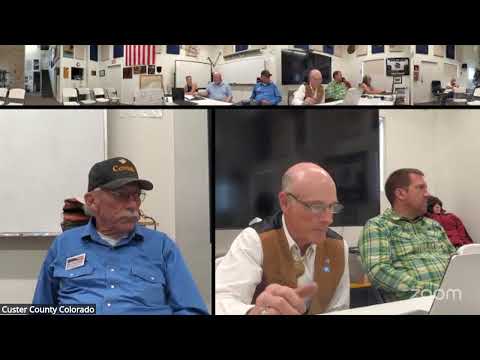
Custer County Board of Commissioners Chairman Bill Kanda said the board would ask the Colorado Department of Local Affairs to begin the process of providing emergency recovery funding to help the county recover from recent fires.
The board voted to authorize staff to open the process with DOLA and return to the board with a specific funding request after county damage assessments are complete. "Today, we can vote on, to start the process with a request to DOLA," Kanda said before moving the motion; the motion was seconded and approved.
Why it matters: County leaders said they need outside capacity to manage recovery work — from FEMA grant administration to debris and infrastructure coordination — and lack the personnel locally to take on the surge in permitting and reconstruction tasks. Sandy Sneed, who identified herself as a regional manager with the Department of Local Affairs, told the board DOLA can support counties either by funding a temporary recovery manager or by contracting with a recovery firm. "I could request this and get an answer within a couple weeks," Sneed said, adding the department could structure matches and time frames to fit local needs.
What was proposed: Sneed and other presenters sketched two approaches: an on‑staff recovery manager or an outside consulting firm. The board discussed a sample package roughly based on peer‑county applications: about $300,000 in personnel costs and $60,000 in consultant fees for an initial scope, with possibilities for DOLA to cover a portion of the first year and step down support in later years. Sneed said DOLA could amend contracts as needs became clearer.
Board concerns and details: Commissioners pressed for clarity on what the county would pay for directly, and how the funding would affect Payments in Lieu of Taxes (PILT) and other county revenue streams. The chair said county teams will complete a building‑by‑building assessment the next day; he noted about "400 structures" had been reported as damaged or impacted so far, a figure the board said it will refine.
Procedural steps: The motion approved authorizes staff to work with DOLA to prepare a formal funding request and return with a defined budget and matching plan once assessments are complete. Commissioner questions about timing and scope were answered with a staff commitment to prepare a revised request for the board’s review.
What’s next: Staff will finalize damage assessments and propose a specific grant amount and matching plan at a follow‑up meeting. The board also discussed coordinating DOLA support with federal recovery programs and local planning and zoning capacity.
Quotes: "We're going to wait until we get it before we apply for the grant," Kanda said, describing the need to assess damage before settling on an exact request. Sneed said, "I just need the exact budget including what you're willing to match," explaining DOLA's internal approval steps.
Ending: The board’s authorization does not commit the county to accept any award; it authorizes staff to prepare and submit a formal request to DOLA and return with the proposed budget and match for the commissioners’ approval.
AI generated
The text on this page is AI generated. Summaries, highlights, analysis, and video transcripts are all produced from the original source material.
AI can make mistakes, so if you spot one, and we will fix it for everyone.
Note: the source content is unaltered by us. Any content source we link to, be it a video, an audio recording, or a document, is presented exactly as its publisher released it. That publisher is usually a government body, sometimes an individual official or another organisation.