Get Full Government Meeting Transcripts, Videos, & Alerts Forever!
Get email alerts on the Local Government topic
No spam. Unsubscribe anytime.
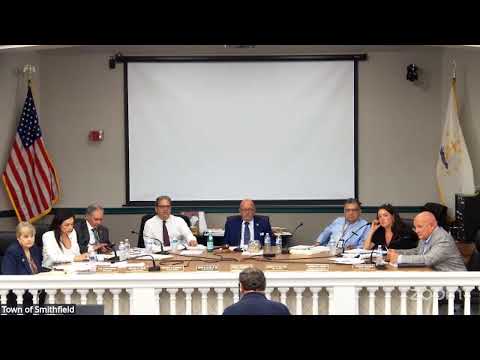
Smithfield council forwards slate of charter amendments to November ballot after extended public input
Summary
After an hours‑long public hearing with extensive testimony from residents, boards and local library leaders, the council approved dozens of Charter Review Commission recommendations (with edits) to appear on the Nov. 3 ballot, including staggered four‑year council terms, website posting of notices, and departmental reorganizations; a municipal library provision was softened to "may" to allow further study.
The Smithfield Town Council voted on July 21 to forward a broad package of proposed town charter amendments to the November 3, 2026 ballot, after a lengthy public hearing led by the Charter Review Commission.
Ernie Almonte, chair of the Charter Review Commission, told the council the commission spent 14 months reviewing the charter and consulting other municipalities before proposing changes to clarify departmental roles, strengthen fiscal oversight and update election and notice procedures. "Our goal is to take an already outstanding foundation and nudge it to an even higher level of excellence," Almonte said when presenting the recommendations (Ernie Almonte, SEG 2015–2024).
Key items the council approved to place on the ballot included:
- Moving town council terms to staggered four‑year terms to preserve institutional knowledge and ease campaign burdens; - Amending notice rules to treat posting on the town website as official notice for specific charter sections; - Removing the requirement that conveyances and leases of town real estate require an ordinance, intended to speed business transactions while preserving public‑hearing safeguards; - Making newly adopted ordinances effective upon adoption unless otherwise specified, rather than waiting 30 days in some cases; - Requiring a bachelor’s degree (specified in the amended motion as in criminal justice or a related field) for the police chief position, with the council adding language to address related qualifications; and - Establishing or clarifying departments (public works, human services, engineering, planning and economic development) with written duties and qualifications for directors.
The proposed municipal library system drew the most sustained public comment. Library trustees and directors from Greenville and East Smithfield urged caution, saying independent nonprofit boards oversee programming, own buildings or control endowments, and that donors prefer supporting nonprofits rather than government entities. "We are open and transparent. We are not here to become a conglomerate library that loses the spirit of our town," said Melissa Maroney, president of the East Smithfield Public Library board of trustees (Melissa Maroney, SEG 3333–3340).
Council members raised the same questions and ultimately adopted a compromise: the charter language will be changed so the council "may" (rather than "shall") establish a municipal library system, allowing more time for planning, consultation and protections for donor funds prior to any structural change.
Votes and next steps
Council moved to approve the ballot wording as amended and directed the town solicitor to incorporate the in‑session edits into the final questions. The council also approved a resolution to publish the ballot language for the general election on Nov. 3, 2026.
Some items drew relatively little debate and were approved by voice vote; others prompted amendments to clarify technical drafting (for example, how "notice" will be defined and the precise wording around department duties and degree or experience requirements).
Why it matters
The package touches on governance (term lengths), transparency (website posting of notices), fiscal oversight (requiring expanded fiscal impact notes), personnel standards and local services (department definitions and the library question). Voters will decide each proposed amendment in November. The council’s change to the library language aims to give time for further study and consultation so any future reorganization preserves community donations, program autonomy and local input.