Get Full Government Meeting Transcripts, Videos, & Alerts Forever!
Get email alerts on the Labor And Employment topic
No spam. Unsubscribe anytime.
Smithfield council pauses public-hearing on ordinance to add town oversight of union contract ratifications
Summary
After a lengthy public hearing with union leaders and residents weighing in, the Smithfield Town Council voted to continue consideration of an ordinance that would require council updates, legal counsel at negotiations and a 14-day fiscal-impact posting before ratification.
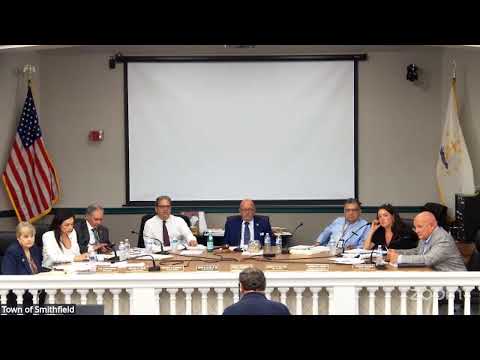
The Smithfield Town Council continued a public hearing on July 21 on a proposed ordinance that would require greater town oversight and public notice of collective bargaining agreements, sending the item back for further drafting and discussion in August.
The ordinance’s sponsor outlined provisions to "require the presence of legal counsel for the town at all collective bargaining negotiations and will allow the town council to appoint one of its members to monitor the negotiations," and to require the town manager to provide regular updates and a fiscal-impact statement at least 14 days before any council ratification vote (Council member, SEG 362–383).
Supporters and some budget officials said the measure aims to keep the council and the public informed about multi-year fiscal commitments. "I would actually build further to say ... I would look for a financial impact statement across all years forecasting out that that contract would be good for," said Ian MacLean, chair of the Budget and Financial Review Board, urging long-term fiscal forecasting for contracts (Ian MacLean, SEG 751–758).
But labor leaders, union officials and some town staff warned that the change could complicate bargaining and invite legal risk. "This creates uncertainty for both parties and may, undermine the bargaining process," said Paul Bowman, vice president of FOP Lodge 17, who urged the council to consider less intrusive ways to increase transparency (Paul Bowman, SEG 648–656).
Town officials also cautioned that altering tentative agreements after union ratification could provoke unfair-labor charges and expensive arbitration. "If you change what you've TA'd after the public comment, you will be going to arbitration," a town official said, noting legal and cost risks of reversing tentative agreements (Town Manager Dennis Henley, SEG 1280–1290 and SEG 1427–1436).
Council members debated multiple technical fixes—whether the measure should be an ordinance or a policy, how to treat tentative agreements (TA) and whether the 14-day posting should be a minimum with exceptions for extenuating circumstances. Several members said they supported elements such as involving legal counsel and earlier financial notices but differed sharply on public-hearing language and the risk of politicizing negotiations.
After more than four hours of testimony and council discussion, the council voted to continue the item to a later meeting for additional drafting and possible compromise language. A motion to continue the public hearing carried by voice vote; council suggested dates in mid-to-late August for follow-up (Council action, SEG 1849–1906).
What happens next
The council directed staff and members to work on amendments that would preserve transparency while reducing the risk of reopening tentative agreements after union ratification. The hearing will return to the agenda in August for further action and a refined draft to consider.
The public hearing drew multiple speakers on both sides, including union representatives and leaders of the Budget and Financial Review Board, and laid out the central tradeoffs: public fiscal oversight versus bargaining finality and the risk of protracted negotiations if contract language is reopened after member ratification.
The council did not adopt the ordinance at the July 21 meeting; instead it paused to let sponsors, counsel and labor representatives refine language and to allow the council to consider whether a policy or an ordinance best balances transparency and bargaining stability.