Get Full Government Meeting Transcripts, Videos, & Alerts Forever!
Get email alerts on the School Funding topic
No spam. Unsubscribe anytime.
Clintondale district seeks 2-mill non-homestead levy to protect school funding
Summary
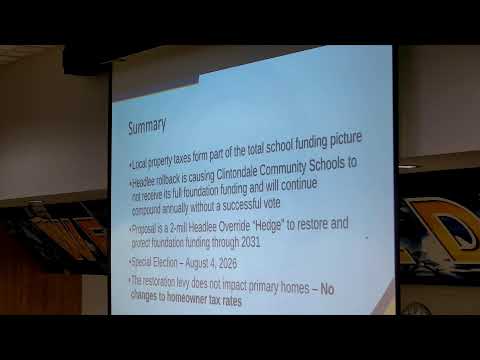
An officer of Clintondale Community Schools urged voters to approve a 2-mill non-homestead operating levy on the Aug. 4 ballot, saying it would not raise taxes on primary homes and would stop compounding revenue losses tied to Headley rollback rules.
An officer of Clintondale Community Schools urged voters to approve a two-mill non-homestead operating levy on the Aug. 4 ballot to restore and protect funding for district operations, saying the proposal would not raise property taxes on primary residences.
"This proposal will not raise taxes on primary homes in our district by a single penny," the presenter said, emphasizing that the measure applies only to non-homestead properties such as commercial real estate, rental units, second homes and vacant land.
The presenter said the district has suffered funding declines tied to state and local rules, citing a $42,000 shortfall in the fiscal year just closed and an estimated $86,200 projected loss for the upcoming school year if the district does not take action. The district's presenter tied the gap to two factors: Proposal A (1994), which reshaped Michigan's school funding by shifting much of the local tax burden to the state and set an 18-mill non-homestead expectation, and the Headley rollback/amendment (1970s), which reduces levy growth after large increases in taxable value.
The presenter said the district currently has an authorized levy of 17.558 mills (about $2,217 per student under current calculations), while the state's per-student foundation figure for the coming year is $10,300. Because the district is not levying the full state-expected 18 mills, the state will not make up the difference, producing a roughly $56-per-student gap that compounds into the cited district shortfall.
On the ballot, the district is asking voters to authorize a two-mill increase to the limitation on taxes for non-homestead property for five years, 2027 through 2031 inclusive, to provide funds for operating purposes. The presenter explained the authorization would raise the district's permitted levy to 19.558 mills on paper but noted the district cannot levy more than the statutory 18 mills in any given year; the extra authorized mills act as a hedge against future Headley rollbacks.
The presenter said a full two-mill levy would be expected to generate approximately $369,000, though the actual amount collected depends on statutory limits and taxable-value calculations. He cautioned that if the measure does not pass, the district will not receive full funding and will need to factor those projected revenue losses into the annual budget, potentially affecting programs and activities for students.
During a brief question-and-answer period, an audience member asked whether election officials release vote choice data for early voters; the presenter said only voter participation (who has voted) is publicly available, not how individuals voted. The same attendee asked whether there is a list of non-homestead parcels that would be affected; the presenter suggested contacting the township clerk or assessor for parcel-level lists.
The presenter closed by thanking attendees, noting absentee ballots are already available, and offering to answer follow-up questions by phone or email through the district office. The election is scheduled for Aug. 4.