Get Full Government Meeting Transcripts, Videos, & Alerts Forever!
Get email alerts on the Land Use topic
No spam. Unsubscribe anytime.
Portland housing committee seeks Planning Commission consideration of RM3 zoning tweaks to speed housing
Summary
The Housing & Permitting Committee discussed transmitting a letter asking the Planning Commission to consider raising base FAR from 2.0 to 2.5, making a 5‑foot front setback the base standard, and aligning deeper‑affordability bonus criteria with state cooperative housing bonus rules; members agreed to soften language to 'consider' and accept sign‑on logistics.
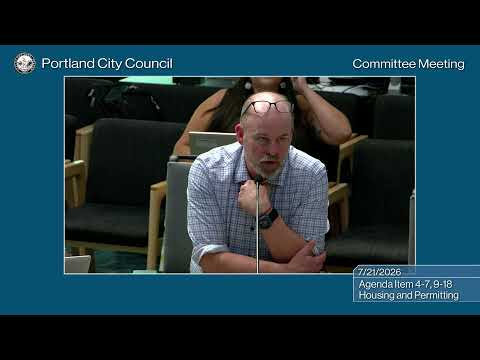
The Housing and Permitting Committee on July 21 debated a nonbinding letter to the Planning Commission that would ask the commission to consider adjusting aspects of the RM3 base zoning framework to help mid‑density housing projects “pencil out.” Chair Abalos and Vice Chair Greene introduced the proposal and sought committee support for sending the letter before the Planning Commission advances its current bonus‑alignment project.
The letter outlines three primary, nonbinding requests: increase the base floor‑area ratio (FAR) in the RM3 base zone from 2.0 to 2.5 to allow more buildable floor area; apply the 5‑foot front setback reduction universally in the base zone (moving the base standard from 10 to 5 feet in those zones); and adjust the deeper‑housing affordability bonus criteria so they align with state bonus criteria used for affordable cooperative housing. Vice Chair Greene said the combination of those changes would give developers more room to design projects such as single‑stair mid‑rise buildings that otherwise struggle to be financially feasible without larger subsidies.
Eric Kingstrom, director of the Bureau of Planning and Sustainability, explained FAR in plain terms: ‘‘it’s a measure of development intensity’’ — for example, a 2:1 FAR on a 10,000‑square‑foot lot yields 20,000 square feet of floor area to stack within height limits. Kingstrom cautioned that changing base standards might prompt additional public engagement because the Planning Commission’s current scope emphasizes bonus provisions, and adding base‑zone changes could stretch the project’s outreach timeline.
Several council members raised concerns about removing incentives from the bonus system. Councilor Perogany warned that moving allowances into the base zone could reduce the city’s ability to ‘‘incentivize certain types of development, like family‑sized units and more accessible units’’ that bonuses are designed to produce. Councilor Novick said he preferred gentler language: urging the commission to “consider” rather than directing a change, and suggested the committee could sign the letter individually rather than sending it on committee letterhead to avoid public‑meetings law complications.
Committee members agreed to soften the phrasing in the letter to ‘‘consider adopting’’ the suggested amendments, remove the committee letterhead so signatories would be individual members, and accept a sign‑on deadline (noon the next day) for councilors wishing to join. The Chair said staff would circulate the revised text the next morning.
The decision to seek Planning Commission consideration is procedural and nonbinding; the Planning Commission may choose to incorporate, reject or further study any suggested changes. The committee did not take a final vote on the letter at the meeting and encouraged members to sign on individually if they wish.