Get Full Government Meeting Transcripts, Videos, & Alerts Forever!
Get email alerts on the Land Use topic
No spam. Unsubscribe anytime.
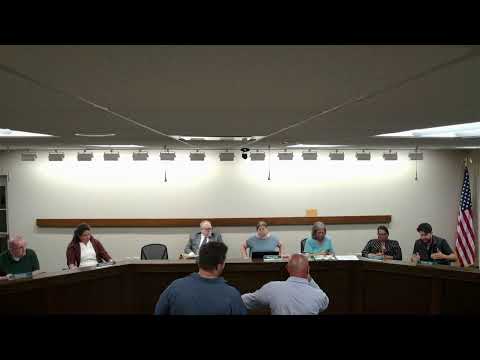
Commercial Point council debates rezoning and TIF plan for 110-acre development
Summary
Councilors and developer representatives debated a tabled ordinance to rezone 110.05 acres in Commercial Point and a proposed TIF and bond package to pay for sewer and road work, with concerns about McCord Road costs, bond structuring and impacts to schools and residents.
A tabled ordinance to rezone about 110.05 acres in Commercial Point and a proposed tax‑increment financing package drew an extended discussion at the committee of the whole meeting.
The presenter said the project would require about "2,400 lineal feet of sewer to the property," new traffic management at the site entrance and significant improvements to McCord Road, and that those infrastructure costs are the principal reason the developer is requesting a TIF and related public‑finance tools to fund construction. Mike Bedford, who identified himself during the meeting, described the proposal as aiming to create a regional infrastructure solution and invited council members to discuss options including a bond fund and tap‑credit arrangements.
Why it matters: Council members said the upfront public cost and where those costs fall — on future residents in the development versus existing taxpayers — are central to whether the village should authorize a TIF. The developer and advisers said the financing would allow the project to move forward and that, under the proposed structure, "no existing properties today would be funding any of that project;" instead, future development's tax flows would service the debt, they said.
Details and debate: Materials discussed at the meeting included a financing scenario showing a $10,000,000 issuance and physical improvements of roughly $6,800,000. An adviser said splitting the request into two bond issuances would increase origination and interest costs but might be necessary given early‑stage buildout assumptions; he also said a county bond fund option could lower interest expense and estimated the village might save roughly $1,000,000 over the life of a $6,000,000 bond in one modeling example. Council members asked for an amortization chart that compares a single bond issuance to the two‑bond approach.
Several members pressed the developer on off‑site impacts, particularly McCord Road. Councilors said McCord is largely outside the village's control and that required changes to that roadway — estimates mentioned in the meeting ran to the low‑millions — could make the project infeasible unless the parties reach an agreement with the township or allocate costs differently. One councilor said, "if that doesn't get touched, we have a problem," and asked for high‑to‑low cost scenarios for roadway upgrades and timing when improvements would be required.
On revenue use and statutory limits, an adviser noted that while some municipalities use excess TIF revenues for broader projects, state statutes constrain expenditures to projects that benefit the TIF district; he said interpretation of that restriction varies and that the village's conservative approach would guide any use of excess funds.
Funding alternatives discussed included using a Delaware County bond fund to get a lower rate, the village issuing a single larger bond, and tap‑credit arrangements where the developer fronts certain costs and recovers them from future lot sales. The developer pointed to prior local projects that used similar mechanisms and said tap credits were previously used to build a water tower.
Local impacts: Several council members raised nonfinancial concerns, including school capacity and the effect on local services; one member urged care about density and unit mix and asked whether a portion of the development could be age‑targeted. The presenter said the plan being discussed included a mix with roughly half targeted to an older cohort, though final unit counts and densities were not yet fixed.
Next steps: Councilors asked the developer and their advisers to provide additional modeling — including single‑issuance amortization schedules and high/low cost estimates for McCord Road work — and to return with clarifying documentation such as traffic‑impact study input and ODOT feedback on the 104 corridor. The ordinance (Ord. 2026‑06) remained tabled at the meeting.
The meeting did not record a final vote on the rezoning; council members said they were open to further negotiation but wanted clearer numbers and written commitments on off‑site road work before advancing the ordinance.