Get Full Government Meeting Transcripts, Videos, & Alerts Forever!
Get email alerts on the Land Use Data Center topic
No spam. Unsubscribe anytime.
Mason County public hearing draws calls for moratorium, larger setbacks and firm protections on proposed hyperscale data center
Summary
Hundreds of residents urged the Mason County Joint Planning Commission to impose a moratorium, expand setbacks to 1,500–2,500 feet, require environmental safeguards and local‑hire rules as the commission reviews a draft data‑center ordinance; developer representatives said the current concept is about 2,000 acres and detailed site plans will follow rezoning.
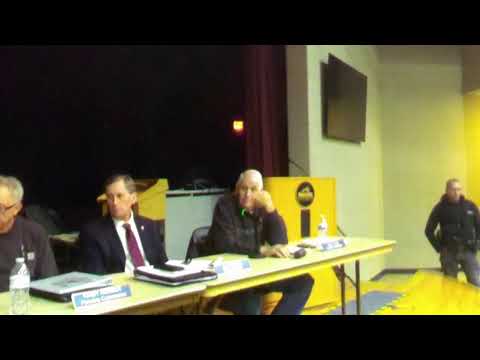
MAYSVILLE, Ky. — Residents crowded a Mason County Joint Planning Commission hearing to press the commission for greater protections and more transparency before allowing a proposed hyperscale data center to proceed.
Speakers at the continuation of a multi-night public hearing urged the commission to pause action and adopt stronger safeguards, while other residents and labor leaders said the project could bring much‑needed jobs if local hiring and safety requirements are enforced.
The hearing featured sustained testimony on three themes: calls for a moratorium and wider setbacks from homes; environmental, noise and water‑quality concerns; and proposals to secure local economic benefits such as a local‑hire clause.
"The current setback projected at 250 feet is grossly inadequate," said Carol Sugars, a resident who asked the commission to require "proper setbacks from property lines of at least 1,500 to 2,500 feet" and written protections during construction for erosion, flooding, noise and light. "I can't even imagine living any closer to a hyperscale data center." (Carol Sugars, public comment)
Other residents recounted personal stakes. Martha Perkins, a retired nurse and multigenerational small‑scale farmer, described health and lifestyle concerns and urged caution. Tim Grocer raised water‑quality fears, citing research about persistent chemicals and asking the commission to allow substantial time for study or block the project. Owen Brown played recordings from a Virginia neighborhood near an Amazon facility and said measured noise reached roughly 55–57 decibels at 250 feet, arguing that those noise levels would degrade outdoor life and sleep near a facility. (Martha Perkins; Tim Grocer; Owen Brown, public comments)
Proponents and labor representatives urged balanced review. Rosslyn Kilgore urged the commission to evaluate economic facts, citing studies that show data centers can boost long‑term tax revenue. Jeremy Jenkins, business manager of Laborers Local 189, said the county should require a mandatory local‑hire clause and use of trained local union trades for construction to ensure jobs, safety and high standards. Dusty Fuller, who owns a business in Mason County, said the investment could attract other companies and spur growth. (Rosslyn Kilgore; Jeremy Jenkins; Dusty Fuller, public comments)
Developer engineer Jack Ammerman told the commission the current project boundary under study is about 2,000 acres "give or take," and said site layout, topography, karst (sinkhole) conditions and utilities shape where buildings and supporting infrastructure are located. Ammerman emphasized that site plans, footprints and utilities are confidential at the present stage and that a preliminary site plan and rezoning application would follow any ordinance changes. (Jack Ammerman, developer design engineer)
Several speakers requested specific ordinance language: larger setbacks and maximum decibel tables for noise; explicit rules about battery energy storage systems (BESS), including location and emergency response; decommissioning or reclamation bonds to guarantee cleanup if a facility is abandoned; and a community benefit agreement or a redacted draft for public review. Elizabeth Berry and others pointed to a recent large lithium‑ion battery fire in Moss Landing, California, and urged the text amendment to address BESS siting and scale. (Elizabeth Berry; Jason Jedwig, public comments)
The commission did not vote on substantive zoning changes. Members took a procedural vote to reenter the public hearing and later closed the public‑comment portion; they asked staff to compile transcripts and all written submissions, prepare a short staff report, and return with a recommendation at subsequent special meetings. Several speakers moved to admit PowerPoint slides, notebooks and model ordinances into the record; the commission noted the requests and said staff will decide what to include at a future meeting. (Chair and staff directions)
What happens next: the commission plans to gather the transcript and written submissions, produce a staff report and schedule special meetings — likely in January — to review proposed ordinance changes and any site plans that accompany rezoning. Multiple residents urged the commission not to rely solely on developer submissions and asked for additional public forums and a transparent timeline before formal rezoning decisions.
The hearing underscored deep community divisions: some residents called for moratoriums and far larger buffers from homes, citing health, farmland preservation and cumulative land‑use concerns; others emphasized jobs, tax revenue and regional competitiveness. The commission closed the public hearing portion after the final comments and moved to regular business, without adopting ordinance changes during the session.
The planning commission reiterated that more technical details — site footprints, utilities and final mitigation plans — will be available only when formal rezoning and site plan applications are submitted, and it asked staff to provide documents and exhibit materials to commissioners for review before the next meeting.