Get Full Government Meeting Transcripts, Videos, & Alerts Forever!
Get email alerts on the Program Progress topic
No spam. Unsubscribe anytime.
Inclusion Works advisory committee reports assessments, referrals and provider-training gains
Summary
At a July 2026 virtual advisory meeting, Inclusion Works leaders reported assessment and referral numbers, new provider-innovation training milestones and tools—Work Together NC reported 143 individual employment assessments and EIPD said 26 referrals had started applications.
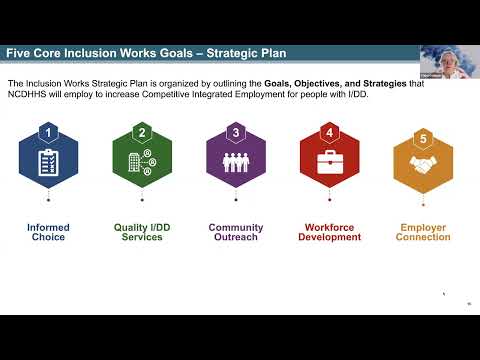
Claire Colligan, IDD employment lead in the Division of Mental Health, Developmental Disabilities and Substance Abuse Services, opened the Inclusion Works Community Advisory Committeewebinar by thanking attendees and outlining the project's one-year implementation and five strategic goals.
"So many people coming to this quarterly meeting so that we can speak to all of you about the great work that is happening with Inclusion Works and the giant strides we continue to try to make for people with disabilities in North Carolina who are choosing to work," Colligan said.
Work Together NC reported the program's assessment work: Barbara, the new Work Together NC project coordinator, said the team worked with 15 providers and "completed employment assessments with 143 individuals with IDD," added 57 family/guardian assessments and completed 10 teacher transition assessment profiles. Barbara credited in-person meetings with participants, families and caregivers for helping finish the assessments.
Adrienne Kittle, program specialist with the Division of Employment and Independence for People with Disabilities (EIPD), described the referral path from assessments to EIPD services: "Right now, I believe we have, about 46 referrals...Of those 46, 26, applications have been taken, and the process has been started with EIPD to assess eligibility," she said, describing a biweekly assignment process to provide warm handoffs to local EIPD offices.
Kittle outlined how EIPD and tailored-plan staff coordinate funding transitions: counselors use a stabilization letter template, EIPD cases typically stay open at least 90 days after stabilization to avoid service and funding gaps, and tailored-plan-funded services are encouraged to begin immediately to maintain continuity.
Catherine Titus of WISE summarized provider-innovation training and early employment results: "So since January 1, there have been 8 new job starts, an additional job offer, and then 5 CIE temporary job opportunities," she said, noting these outcomes represent 14 people with expanded opportunities in the last six months. Titus described WISEonline Academy 100 series training (ACRE-core competencies) and a follow-up 200 series with limited spots for certified staff.
The committee also highlighted tools and supports intended to ease transitions to work. Colligan promoted a North Carolina version of Disability Benefits 101 to help participants model how wages would affect benefits. The group discussed Trillium Health Resources' "Ultimate Living Assistant" tablet tool (to be renamed Technology Ultimate Living Assistant) that provider-innovation grantees are piloting to support independence and job tasks.
Why it matters: the meeting combined outcome numbers, operational details on assessment-to-service handoffs, and training resources meant to expand competitive integrated employment options for people with intellectual and developmental disabilities across the state.
Next steps: leaders said slides and the recording will be posted on the Inclusion Works website and that a one-year strategic-plan review will be published in fall 2026; the next advisory meeting is scheduled for Oct. 20 at 11 a.m.