Get Full Government Meeting Transcripts, Videos, & Alerts Forever!
Get email alerts on the Stable License 88 100 Mill Lane topic
No spam. Unsubscribe anytime.
Yarmouth Board of Health delays decision on Mill Lane goat farm after contentious public comment
Summary
After hours of testimony about a proposed stable license for 88 & 100 Mill Lane, the Yarmouth Board of Health on July 20 deferred a decision and voted to hold a work session with town counsel to resolve variance and compliance questions raised by neighbors and applicants.
YARMOUTH PORT, Mass. — The Yarmouth Board of Health on July 20 declined to grant or deny a stable license for a proposed goat farm at 88 and 100 Mill Lane, instead voting to schedule a board work session with town counsel to resolve legal and technical questions after more than two hours of testimony from neighbors, experts and the applicants.
The application from the owners of Good Hope Farm would allow hoofed animals on the property; neighbors pressed the board to deny the permit, citing the town's stable regulations that limit hoofed animals to two per acre, and arguing that the application lists 1.44 acres of usable corral area. "The number of animals to be allowed is totally at the discretion of the Board of Health," said Lisa Trugrady, a Yarmouth Port resident, adding that "I ask that you deny this application for this property." The board did not take a final vote on the license.
Why it matters: Hallett's Mill Pond is a conditionally approved shellfishing area monitored by the Division of Marine Fisheries, and neighbors and health professionals warned that increased animal density and inadequate manure controls could raise risks to water quality and public health. Several residents and a physician who testified by Zoom highlighted potential e.coli and other fecal contamination risks.
What supporters and applicants said: The applicants and their attorney said the project is consistent with prior permits for portions of the land and that conservation and DEP reviews have addressed wetland and setback issues. Dan Ojala, a civil engineer for Down Cape Engineering, described engineered berms and a swale designed to intercept runoff and a covered concrete manure-storage pad sited away from the pond. "This intercepts that water, shunts it off to the north and puts it on the other side of a large hill from the Mill Pond," Ojala said, describing the drainage design.
Owner testimony: The owner, identified in the hearing as Natasha of Good Hope Farm, emphasized long family experience in farming and said the operation would follow best-management practices. "This is our home. We will live there, we will wake up there, we will drink the same water, we will breathe the same air," she said, asking the board to judge the application on the written plan and her record of animal care.
Key legal dispute: Neighbors argued the stable regulations require an applicant to seek a variance for uses inconsistent with current rules and that prior variances or permits from the 1980s and 1990s may not transfer to a new applicant or a different parcel. A neighbor-attorney presented statutory and regulatory citations, including the standard governing Board of Health variances (105 CMR 400.800), arguing the applicants had not requested a variance and had not shown the manifest injustice or hardship required to obtain one.
Board response and next steps: Board members said the packet of historical minutes, DEP materials and engineering plans would require close review. The board voted to schedule a working session to examine the variance issue and application completeness with town counsel present; the chair said the board must comply with open-meeting law and would post the session. The board did not close the public record and indicated it would look for additional legal guidance and technical clarification before making a final decision.
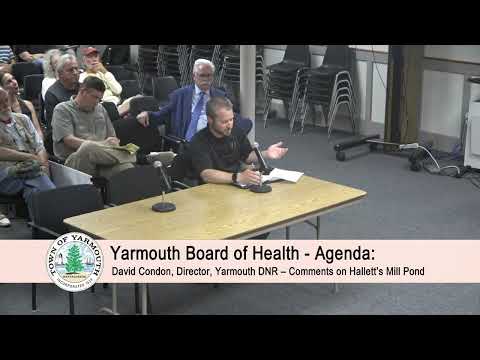
Other context: Earlier in the meeting the town's director of natural resources described Mill Pond as "conditionally approved" for commercial shellfishing and said state marine biologists sample the pond multiple times each year. The meeting also included a short presentation on tick-borne disease prevention.
The board adjourned after routine business; no stable-license decision was made at this session. The work session date will be posted on the town calendar and the board said members and staff would notify interested parties.