Get Full Government Meeting Transcripts, Videos, & Alerts Forever!
Get email alerts on the Municipal Budget topic
No spam. Unsubscribe anytime.
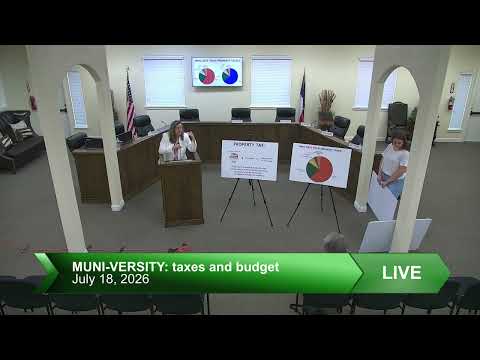
Willow Park official explains property-tax and budget basics at public workshop
Summary
City of Willow Park staff used a public workshop to explain how property taxes are calculated, who receives the revenue, the role of appraisal districts, how the city budgets and finances capital projects, and fielded residents’ questions about reserves, annexation and development incentives.
Rose Hoffman, director of communications for the City of Willow Park, led a Saturday morning workshop to explain how property taxes and the municipal budget work, using the city’s approved fiscal 2025–26 numbers as examples and answering residents’ questions.
Hoffman opened by cautioning that the slides use last year’s approved budget as examples because certified appraisal values for the new year were not yet final. “Rising tax rates in Willow Park are not the reason your taxes are going up. Rising appraisal values are the reason your taxes are going up,” Hoffman said, underscoring that the city controls only the tax-rate portion of the calculation while the county appraisal district sets property values.
Why it matters: Property-tax bills combine multiple taxing entities. Hoffman used a $300,000 home to show distribution and said roughly 61% of the property-tax portion in the example went to Aledo Independent School District, about 21.6% to the city of Willow Park, with smaller shares to Weatherford College, the emergency services (fire) district, the Parker County Hospital District and the county road fund.
On the city’s books: Using the 2025–26 budget as an example, Hoffman said the city budgeted about $4,073,000 in property-tax revenue and $2,175,000 in sales-tax revenue; other revenues (permits, rentals, franchise fees) were shown as roughly $1,473,000, producing total projected spending of $7,721,000 in the slides. Hoffman said the city divides its tax rate into maintenance-and-operations (M&O) and interest-and-sinking (I&S, debt service); the slides showed approximately $1,922,000 for M&O and about $2,150,000 for I&S in that budget.
On debt and financing: Hoffman described municipal borrowing as a standard way to pay for infrastructure without deferring costs for decades, saying Willow Park carries general fund debt in the slide example of about $20 million and has been financing at roughly 3–5% interest. “It is not an indication of poor financial health,” she said, adding that borrowing spreads costs equitably across current and future beneficiaries of projects.
City staff member Michelle summarized the common types of local debt residents asked about: certificates of obligation (long-term, typically 20–30 years and issued with council approval), general obligation bonds (voter approval required, often 10–30 years), and tax notes (shorter, around seven years, sometimes callable sooner). “The type of debt depends on the project and the useful life of what you’re financing,” Michelle said.
Public questions and operational details: Residents asked how apartment taxation works, and Hoffman explained property taxes are paid by the property owner, not renters. She also said Texas requires cities to keep about 180 days (roughly six months) of operating costs in reserve and reviewed the city’s audit and budget calendar: budget discussions begin in spring, certified appraisals arrive in late July, council workshops occur in July, public hearings happen in August and September, and officials usually aim to adopt the budget and tax rate before the Oct. 1 fiscal-year start.
Other neighborhood concerns: Hoffman addressed common questions about annexation and the city’s extraterritorial jurisdiction (ETJ), saying property owners must petition to be annexed and the city cannot annex private land without consent. She noted that Willow Park shares ZIP codes with neighboring cities in parts of town, which can cause address confusion. On sewer expansion, staff explained that for some older homes with on-site sewage systems (OSSF) converting to city sewer requires enough willing connections to be economical.
Next steps: Hoffman said the city will post the workshop video and slides on the city’s outreach (University) page and invited residents to follow up with city staff for clarification or one-on-one conversations.
The workshop was educational in nature; no formal council actions or votes were taken during the session.