Get Full Government Meeting Transcripts, Videos, & Alerts Forever!
Get email alerts on the Watershed Assessments topic
No spam. Unsubscribe anytime.
Clinton County drainage board raises assessments across multiple watersheds to cover maintenance shortfalls
Summary
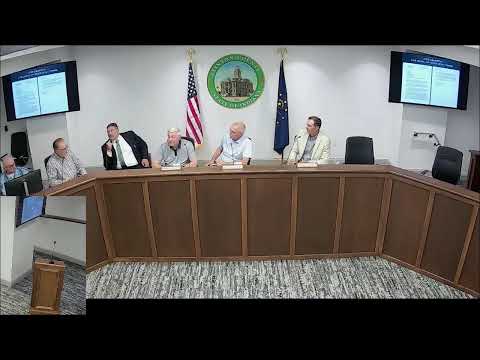
At its July 21 meeting the Clinton County Drainage Board approved increases to annual assessments for several watersheds after surveyor reports showed persistent deficits and rising maintenance costs; most motions passed unanimously 3–0 amid public questions about past spending and contractor work quality.
The Clinton County Drainage Board on July 21 approved higher annual assessments for multiple local watersheds after county surveyor Daniel Sheets told the board existing rates were insufficient to fund needed maintenance and repairs.
Sheets presented classification reports for each watershed, detailing miles of tile and open drains, current account balances and average annual maintenance costs. For the William Irwin Watershed (No. 531) he recommended raising the rate from $3 to $4.50 per acre with a $40 tract minimum, a change estimated to collect $17,734.99 annually. Sheets gave similar recommendations for other watersheds, including Robert Miller (No. 545) to $3.50/acre ($35 minimum, $39,772.29 projected) and Sarah Taylor (No. 568) to $7/acre ($50 minimum, ~$41,227.21 projected) to cover deficits and planned projects. "Since the rate is insufficient to keep up with the annual maintenance demands, therefore it is my recommendation that the assessment be increased," Sheets told the board.
Board members cited rising contractor and fuel costs as drivers of the increases. "Prices have raised for the cost of what we have to do," one commissioner said during discussion, noting the board has limited options when a watershed is operating in the red. Motions to approve the surveyor's classifications and the proposed assessment increases carried 3–0 for each watershed.
Several landowners and residents questioned the changes during public comment, asking why some watershed accounts were in deficit despite years of assessments. One landowner asked, "We've been paying taxes all these years, so where'd the money go?" Surveyor Daniel Sheets and staff explained that some funds were spent on tile collapses and emergency repairs, and that the board sometimes borrows from a county general drain improvement fund to finance urgent fixes that later are repaid by the watershed.
Residents also raised concerns about contractor performance on ditch-cleaning jobs and asked for clearer documentation of expenditures. In response, staff said the county bids projects and has removed contractors from bidding lists when work proved unsatisfactory; staff also agreed to explore publishing an annual spending summary for watershed account activity so landowners can see how funds are used.
The board certified each approved action to the auditor and directed the surveyor to notify affected landowners. Many of the approvals carried standard next steps: certification, notification to landowners and authorization for the president to sign orders when completed.
The board also discussed longer-term timelines for larger reconstruction projects, saying some substantial ditch reconstructions may require multi-year fund buildup or grant funding (which the surveyor said is effectively unavailable for most drainage projects). For one watershed the board noted planned multi-thousand-foot pipe installations that justified a larger, time-limited assessment.
The drainage board will publish certification orders and notify landowners of the new assessment rates; the surveyor's office will also provide further project-level updates and has been asked to make spending records more accessible to watershed members.