Get Full Government Meeting Transcripts, Videos, & Alerts Forever!
Get email alerts on the Road Acceptance topic
No spam. Unsubscribe anytime.
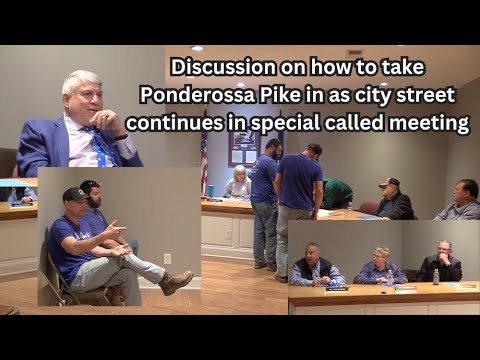
Jamestown council tables decision on taking Ponderosa-area road into city system
Summary
The Jamestown City Council paused action March 27 on whether to accept a road leading to Ponderosa Park into the city street system, asking staff to pull plats, confirm easements and return with full cost and drainage estimates before deciding.
The Jamestown City Council on March 27 paused a decision on whether to accept a private road that provides access to property near Ponderosa Park, directing staff to gather recorded plats, confirm easements and return with complete cost estimates that include drainage, base rock and paving needs.
Council members convened the special meeting after property owner Brian Young asked the city at a prior session to take the road into the municipal street system. Council members said they had toured the area and reviewed a cost sheet provided that morning showing two price lines: one for a 12-foot roadway and a higher one for a 20-foot roadway.
The central questions for the council were who would pay to bring the road up to city standard, whether recorded plats or easements already reserve a public right-of-way, and how to address existing drainage that has washed away gravel along the alignment. A council member read aloud a 12-foot quote: "$14,005.70 at 12 foot wide." Council members noted city streets are commonly expected to meet a wider standard — roughly 20 feet — which would add width and cost.
Young, the property owner who spoke at the meeting, told the council he was willing to prepare the road base and provide labor, haul gravel and contribute cash toward paving, but said he could not shoulder the full paving cost alone. "I'll put the pile in. You all furnish the pile of rock. I'll do the labor, haul the rock, and I'll put $5,000 toward the blacktop," Young said, asking the council to specify what the city would pay and what he would be expected to finish before paving.
Council members and residents raised drainage and easement issues as potential showstoppers. Speakers said runoff from Fair Oaks Drive and an undersized or obstructed drain tile have washed away gravel, leaving the roadway eroded in places and creating a dead end with limited turnaround capacity. One resident described the stretch as a "daggone mud hole" when it rains and said additional tile or ditch work may be required to stop repeat failures.
Members also discussed who would benefit if the city took the road in; the group named several adjacent landowners who would gain access. Councilors emphasized the need to confirm whether the alignment and width are recorded on plats at the county assessor or clerk’s office and whether reserved easements exist that would cover the widening to 20 feet.
To move forward, a council member moved to table the question pending more information. The council directed staff to pull recorded plats and survey maps, collect a full cost estimate that includes base rock, drainage/tile work and paving, and verify any local ordinance that requires a 20-foot minimum for city streets. The council asked for the information to be returned promptly; members indicated they expected to consider the matter again after those details and costs were verified.
No formal vote on taking the road into the city system was recorded at the meeting. The council’s action was procedural: to gather the recorded easements and a comprehensive cost breakdown before any final decision or ordinance change.
The council did not set a firm date for reconsideration but asked staff to report back once the plats and cost estimates are available.