Get Full Government Meeting Transcripts, Videos, & Alerts Forever!
Get email alerts on the Municipal Finance topic
No spam. Unsubscribe anytime.
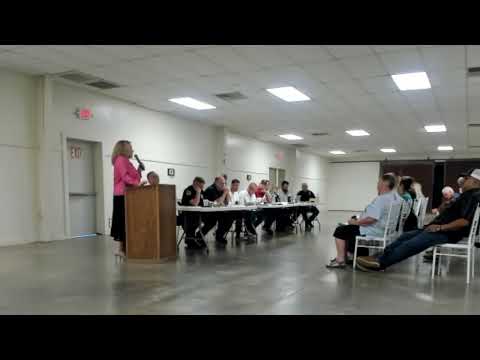
Residents press city leaders over special‑tax (CFD) levies at Ione town hall
Summary
At an Ione town hall, residents challenged city officials about Community Facilities District (CFD) levies that apply to some neighborhoods but not others; staff outlined the districts’ history, said the June levy will yield roughly $625,828 across CFDs and that about $312,000 would go to police and $312,000 to fire, and offered follow‑up data and ballot options.
At a town hall meeting in Ione, residents pressed city officials about Community Facilities Districts — special tax districts that the city uses to pay for services tied to development — arguing the levies are unfair because they apply to some neighborhoods and not others.
A resident asked why only homes in Castle Oaks and parts of Wildflower pay the CFD tax while other neighborhoods do not. City staff responded with a history of the districts dating to 1989: early phases funded lighting and landscaping, later phases and bond restructures left some earlier homes without the later levies, and developers approved some district votes while new neighborhoods were added under later agreements.
City finance staff said the council approved a levy across CFDs on June 16 that staff described as roughly $625,828 total. Staff said the CFD portion earmarked for police would be about $312,000 and the CFD portion for fire about $312,000; they contrasted those amounts with the police budget figure of about $2.6 million and the fire operating budget, which they described as about $1.3 million.
Several residents asked for more transparency about how the numbers appear on tax bills and why some accounts were frozen at lower applied rates while others were charged the current rate. City staff explained the distinction between an applied rate (what a property pays when it was placed into the district) and the maximum tax rate, and said the council previously froze applied rates for some properties rather than the underlying tax-rate increases. Staff offered to provide residents with charts, the underlying calculations and assessor‑office records and to meet individually to explain specific bills.
Speakers suggested a citywide ballot measure as a possible long‑term fix. Staff said they had previously analyzed a citywide tax and that a ballot approach would require significant outreach: convincing hundreds of property owners to approve the change and budgeting roughly $10,000 or more to place an item on the ballot. The manager and council members also noted the practical effect of removing a CFD without a replacement: it could reduce funding for police and fire unless an alternate revenue source is created.
The city offered residents more detailed follow‑up at City Hall and promised to make vendor and payment reports and the CFD calculations available to interested homeowners. No formal council action was taken at the town hall; staff said the topic will continue to appear in future council agendas and budget meetings.
What’s next: staff invited residents to request account‑specific explanations and said charts and supporting documents will be available at the upcoming budget meeting.