Get Full Government Meeting Transcripts, Videos, & Alerts Forever!
Get email alerts on the Housing Tree Code topic
No spam. Unsubscribe anytime.
Wilsonville staff begin second phase of housing code audit, pressing clear tree‑removal standards required by state law
Summary
City planning staff and consultants opened Part 2 of a housing statutory compliance audit focusing on HB 21 38 requirements, including clear‑and‑objective tree‑removal standards, middle‑housing land‑division changes and definitions for household uses. Councilors pressed for guidance on setbacks, native species and mitigation to limit damage to sidewalks and homes.
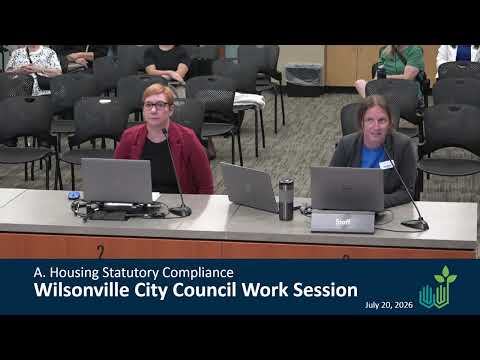
Wilsonville planning staff and their consultants on Tuesday opened the second phase of a housing statutory compliance project that will translate recent state legislation into local development‑code changes.
“We started work on this about eight months ago,” said Kim Bridal, senior planner with the city’s planning division, introducing the scope of Part 2. Bridal and consultant Lee Alligood of 3j Consulting said the work will focus on provisions in recent bills — most prominently House Bill 21 38 — that require cities to adopt clear, objective standards for tree removal and address a range of middle‑housing and code‑cleanup items.
Bridal said staff will publish draft code amendments this fall and that, because some statutory provisions take effect before the city finalizes code text, staff will apply state law directly in the interim while preparing local implementing language.
Alligood summarized key topics the team will evaluate: “HB 21 38 requires that all cities or jurisdictions have to create clear and objective tree removal standards for residential development,” he said, and staff will also consider changes to middle‑housing lot divisions, household definitions and the conversion of some commercial buildings to residential use.
Councilors used the work session to press for operational detail and to flag local priorities. Councilor Scholl asked how the city’s 1:1 tree mitigation requirement would be applied to established neighborhoods where replacement trees cause future sidewalk and house damage; Scholl said many older trees in Villabois now have root balls that interfere with homes and sidewalks. “So my suggestion there would be some type of rules…in terms of what type of trees you’re using and what the setbacks away from the homes would be,” Scholl said.
Staff confirmed the city currently requires either one‑for‑one replacement or a payment into the city tree fund when removals occur, and that the statute still allows an optional discretionary review path for applicants who prefer the city’s existing process. Bridal and Alligood said staff is considering a city‑retained tree‑survey processing model — like the way the city manages traffic studies — to promote consistent, quality analyses.
Council members also asked about other statutory changes that will affect the development code: childcare uses and family child‑care homes, allowances for residential care facilities in non‑industrial zones, and provisions that prohibit requiring traffic‑impact analyses for many middle‑housing projects. On traffic questions, Alligood said the statute limits the city’s ability to require certain traffic studies for small infill projects and recommended staff examine alternatives and timing.
Bridal said the planning commission has reviewed the concepts and offered initial feedback. Staff will return this fall with outreach materials and draft code language for additional council review and public engagement.