Get Full Government Meeting Transcripts, Videos, & Alerts Forever!
Get email alerts on the Digital Engagement topic
No spam. Unsubscribe anytime.
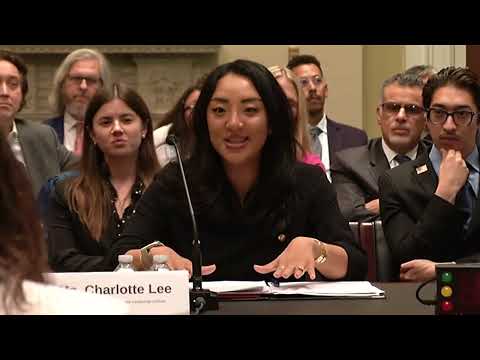
Witness Miss Lee urges House websites to adopt a "digital voice" through social platforms and APIs
Summary
Miss Lee told a House committee that government sites such as house.gov and congress.gov function as static resources and recommended using social platforms, APIs and structured content so official information can participate in conversations where constituents already are.
A questioner asked Miss Lee to expand on her line that a website "waits to be visited while a voice travels," and she described practical steps to give house.gov a "digital voice." Miss Lee said generative artificial intelligence is reshaping how people search for and find government information and urged the House to make official content discoverable and responsive where people already interact online.
Miss Lee, testifying as a witness, cited what she described as Pew research — spoken in the hearing as "29 or 69,000 Google searches" — and said the study found people clicked through to websites 8% of the time when an AI-produced summary appeared versus 15% without a summary. "I think we can turn content into conversation based on where it is happening," she said. "When you post on Reddit or in Facebook, you can respond, like, right away."
She recommended that congressional websites and staff invest in mechanisms that allow information to be active and dialogic: embedding APIs, building platform-specific responses, and cultivating an outbound communications function that goes where constituents are instead of waiting for users to pull information. "I can always appreciate the role of congress.gov and house.gov, like, as a website, but I feel that there is a digital voice that is lacking," Miss Lee said, later pointing to a recent U.K. communications office as a model for proactive outbound messaging.
On the legislative side, Miss Lee said drafting practices that treat bills as permanent make lawmakers and staff extremely cautious, which can reduce opportunities for public conversation. She argued that the decline of traditional public fora — the "soapbox" — has concentrated signaling into formal texts rather than open exchange. "We've lost that actual public forum," she said, adding that improving 1-to-many communication (authoritative, discoverable messages) is a precursor to healthier two-way dialogue.
The questioner pressed on whether more dialogue required respectful, thoughtful exchanges to increase bipartisanship. "How could you get more bipartisanship? How could you get more dialogue?" they asked, adding rhetorically that turning off the Internet would address some problems of anonymity and incivility. Miss Lee responded that dialogue doesn't always mean back-and-forth debate; it can be confirmation or acknowledgement and that structural improvements to how official information is surfaced can help.
The exchange concluded with the questioner thanking Miss Lee. No formal actions, votes or directives were recorded during this line of questioning.