Get Full Government Meeting Transcripts, Videos, & Alerts Forever!
Get email alerts on the Public Access topic
No spam. Unsubscribe anytime.
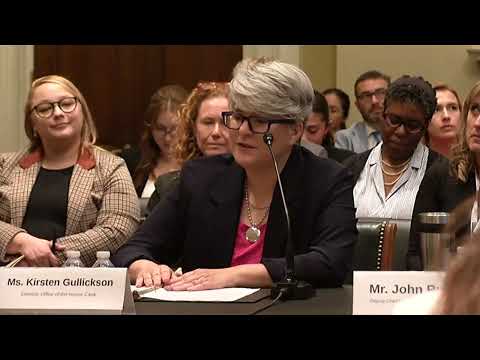
Witness urges House to modernize public access to congressional information
Summary
A witness testifying before the House Administration Committee urged a data-first modernization of congressional information, proposing that house.gov be a clearer public front door, websites share consistent navigation, and Congress adopt structured legislative data standards.
A witness testifying before the House Administration Committee urged Congress to modernize how it publishes legislative information so the public can find authoritative material more easily.
The witness, who said they have worked with the House for more than three decades and began in 1993, told the committee that technology has transformed access to legislative information and that Congress must ensure its information remains trustworthy and understandable. "Congress is not only a lawmaking institution, it is one of the nation's most important information institutions," the witness said.
The witness framed three concrete recommendations. First, "www.house.gov should evolve into a clearer public front door," helping people find authoritative information without needing expert knowledge of House or legislative-branch structures. Second, the witness urged a more consistent experience across House websites using familiar navigation and design patterns so people can find what they need when they need it. Third, the witness recommended that Congress adopt a "data-first" strategy grounded in user research and designed around how people and systems discover, access, verify, and use congressional information.
On technical standards, the witness emphasized the role of structured data. "Better standards produce better data," the witness said, and named adoption of standards such as "United States legislative markup" as foundational to producing machine-friendly, trustworthy outputs. The testimony traced the evolution of congressional publishing systems, noting that early efforts such as GPO Access and Thomas evolved into today's govinfo and congress.gov repositories, and described those changes as evidence of the value of sustained investment and cross-branch collaboration.
The witness warned that most users do not start on congressional websites; instead, they begin with search engines, apps or AI tools. Because of that behavior, Congress should provide both "intuitive journeys for people and trusted structured data for the digital systems they increasingly rely upon," the witness said, so third-party tools lead users back to authoritative sources.
On implementation, the witness recommended an iterative, phased approach: begin with user research and discovery, then progress through information architecture and user-experience design, delivering improvements continuously rather than pursuing a single large modernization project. The witness said such a roadmap could allow Congress to adapt quickly as technology changes while maintaining public trust in its information.
The witness concluded by thanking the committee and saying they looked forward to further discussion. No formal committee action or votes were recorded in the provided transcript.