Get Full Government Meeting Transcripts, Videos, & Alerts Forever!
Get email alerts on the Land Use topic
No spam. Unsubscribe anytime.
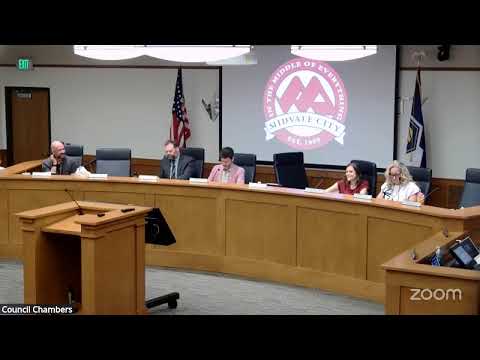
Midvale council tables Greenwood Avenue duplex-overlay rezoning amid resident opposition; asks for development agreement
Summary
After hours of public testimony, Midvale City Council voted 4–1 on July 21 to table a proposed duplex-overlay rezoning for properties near Greenwood Avenue and 7500 South while staff and the developer negotiate a development agreement that limits unit count and protects adjacent single-story homes.
The Midvale City Council on July 21 voted 4–1 to table a proposed rezoning that would add a duplex overlay to parcels at 620 East Greenwood Avenue and the nearby 7500 South/700 East site, directing staff and the project applicant to negotiate a development agreement with specific protections for neighbors.
The proposal from developer Brad Reynolds would have allowed roughly 34 units in a mix of single-story "ramblers" and multi-story townhomes on the former church property. Senior planner Elizabeth Arnold told the council the application met two of the city’s rezone criteria and that the planning commission recommended approval. Reynolds said the project would include masonry or hardy-board exteriors, two-car garages, and parking above code.
Neighbors who spoke at the public hearing urged the council to deny the overlay. Common concerns included potential increases in traffic and on-street parking near a four-way stop that feeds Hillcrest High School, preservation of neighborhood character and trees, protection of canal and existing water rights, and risk of absentee ownership and rentals. Resident Christopher Evans, who said he read the 51-page packet, argued the proposal conflicted with the general plan’s stability-area designation and urged the council to preserve single-family zoning.
The council heard technical input from a traffic consultant retained for the developer, who summarized his memo: the development would generate about 220 daily trips and roughly 18 peak-hour trips (about one additional vehicle every three minutes during peak hour), representing an estimated 3–4% increase on nearby roads. The consultant said national trip-rate data can make townhomes comparable to single-family development on a per-parcel basis.
Councilmembers raised questions about parking, driveway design, phasing and the risk that a future owner could redevelop or convert units. Several members asked whether the developer would agree to a binding development agreement and requested concessions including keeping units that abut existing single-family lots to single-story "ramblers" and improving driveway/parking configurations.
The council’s direction to staff and the applicant specified the items to be included in the development agreement: a cap at 34 units; single-story ramblers along the south and west edges adjacent to existing houses; individual subdivision of lots (to enable ownership rather than a single-title HOA lot); and maximizing full driveways where feasible to reduce on-street parking pressure. The motion to table and send the developer back to negotiate passed 4–1, with Council member Heidi Robinson voting no.
The council recorded no final rezoning action; the matter will return to a future meeting once staff and the applicant present a development agreement that matches the council’s requested terms.