Get Full Government Meeting Transcripts, Videos, & Alerts Forever!
Get email alerts on the Police Budget Cameras topic
No spam. Unsubscribe anytime.
Pulaski police say $63,000 budget drop reflects staffing, not cuts to operations; chief defends state-regulated license-plate readers
Summary
Chief Kelly told the council the police budget is $63,000 lower than last year because higher-paid supervisors left and were replaced at entry pay, while operational spending — including training, equipment and three Flock license-plate readers — was maintained or increased. A public commenter later raised privacy and ticketing concerns about the cameras.
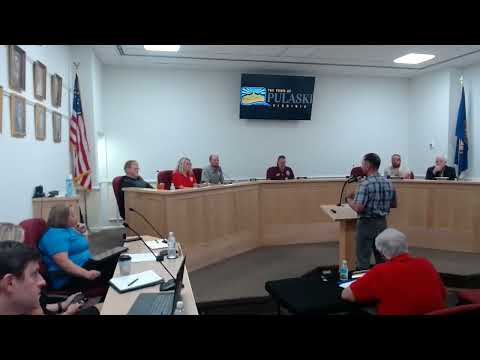
Chief Kelly, Pulaski’s police chief, told the town council that the police department’s current fiscal-year budget is $63,000 less than last year but that the reduction reflects staffing changes, not cuts to operations. "The $63,000 difference from last year to this year's is solely attributable to hiring new entry level officers to replace more senior ones who had left the department," Kelly said, explaining that eight full-time and one part-time officer left between the two budget cycles and that six of the departures were supervisors with higher salaries.
Kelly said roughly 90% of the department’s budget goes to officer salaries and benefits and about 10% goes to operational costs such as equipment, fuel and facility needs. He said the department has added training, communications funding, accreditation work and two new patrol vehicles this year. He also described the role of two part-time, retired Pulaski officers who handle specialized tasks such as background checks and hospital mental-health responses and who continue to receive state retirement benefits.
On technology, Kelly said the department uses three Flock license-plate readers and that the agency leverages those records both to further investigations and sometimes to exonerate people. "Flock is state regulated," Kelly said, adding that officers must document investigations that rely on a Flock query and that monthly audits are run to ensure queries are lawful.
During council discussion, a member pointed out that a decline in a single health-insurance line item — cited as about $78,000 lower — accounted for most of the apparent reduction in the budget, noting that when that is considered the department’s total spending effectively increased.
At the start of the public-comment period, resident Melinda Music raised privacy and ticketing complaints about the Flock system and about road maintenance. Music alleged that "not only do the police department have access to those Flock cameras, but so do foreign entities" and said an overseas individual she named could see license-plate images and personal data. She also asserted that automated-ticketing payments were being converted into British pounds rather than U.S. dollars. The council did not provide a technical rebuttal in the meeting record to Music’s claims; Kelly asserted earlier that Flock use is governed by state law and subject to auditing.
The council did not vote on additional funding for the police department at this meeting. Kelly invited residents to speak with him afterward about questions on staffing or Flock usage.
The council will consider budget items in other sessions; no formal change to police operating policy or contracts was recorded at this meeting.