Get Full Government Meeting Transcripts, Videos, & Alerts Forever!
Get email alerts on the Access To Justice topic
No spam. Unsubscribe anytime.
LSC podcast guests urge simpler courts, more funding and broader helpers to close U.S. "justice gap"
Summary
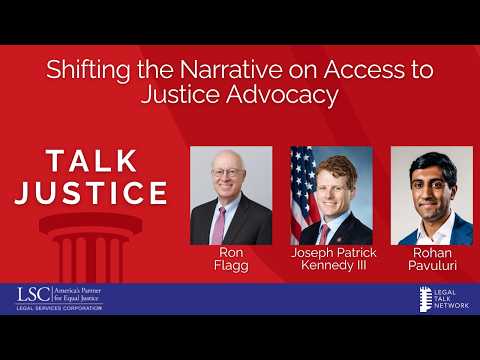
On the Legal Services Corporation's Talk Justice podcast, LSC President Ron Flagg interviewed former Rep. Joe Kennedy and Upsolve CEO Rohan Pavluri, who urged more federal funding, simpler court processes, and expanded roles for nonlawyer providers to help low-income Americans access civil legal rights.
On the Legal Services Corporation’s Talk Justice podcast, LSC President Ron Flagg hosted former U.S. Rep. Joe Kennedy and Upsolve CEO Rohan Pavluri to discuss strategies for closing the U.S. civil “justice gap,” urging more federal funding, simpler court procedures and broader use of nonlawyer assistance.
Kennedy, introduced as a founder of Project Groundwork and a former representative from Massachusetts, framed the problem around enforcement: civil legal rights exist in statutes and regulations, he said, but they matter only if people can access them. "We have chronically underfunded this legal system," Kennedy said, adding that LSC grantees were turning away about 40% of eligible clients who reached their doors before the pandemic.
Pavluri said the barriers include both cost and complexity. "Legal fees in so many areas of poverty law are like modern day poll taxes," he said, arguing those fees prevent low-income people from exercising their civil rights. He recommended simplifying forms and court procedures so people can self-help when a lawyer is not available, and expanding who may provide routine assistance.
Flagg, the podcast host and president of the Legal Services Corporation, cited LSC’s own data to underscore the scale: a pre-pandemic justice-gap study found only about 14% of low-income civil legal problems were met with adequate assistance; during the pandemic LSC estimated that representing all eligible households facing eviction would have cost roughly $2.5 billion. Flagg noted LSC grant funding rose from about $400 million in 1994 to about $465 million three decades later, which guests said falls far short of need.
Pavluri described Upsolve’s approach as an example of simplifying access: the organization built tools enabling people to pursue bankruptcy without a lawyer and, he said, "200,000 people per month come to Upsolve," with about $400 million in debt addressed through that work in the past 2½ years. He urged legal systems to follow models from other professions, where nonphysician clinicians deliver meaningful services under supervision.
Both guests emphasized policy and cultural shifts in addition to funding. Kennedy said Congress "could give more money, and Congress should give more money," but added that lawmakers also need better knowledge about how civil legal services operate. Pavluri called for revising state rules that restrict who may offer legal help (commonly called unauthorized-practice-of-law rules) so more trained nonlawyers can assist in routine civil matters.
The episode closed with Flagg thanking the guests; no legislative proposal or formal action was announced during the conversation. A podcast disclaimer noted guest views were their own and the episode is for informational purposes, not legal advice.