Get Full Government Meeting Transcripts, Videos, & Alerts Forever!
Get email alerts on the Historic Preservation Program topic
No spam. Unsubscribe anytime.
Laguna Beach studies tightening Mills Act rules and adopting a historic‑context framework
Summary
Staff presented four policy options to strengthen Laguna Beach’s historic‑preservation program — revisions to the Mills Act, pursuing certified local government status, preparing a historic context statement, and a certificate of appropriateness — and the council signaled priority for Mills Act fixes and a context statement; staff will return with recommendations and timing.
Laguna Beach staff on Tuesday asked the City Council and Heritage Committee for direction on four measures intended to strengthen the city’s historic‑preservation program, and council members signaled they want staff to prioritize changes to the Mills Act program and creation of a historic context statement.
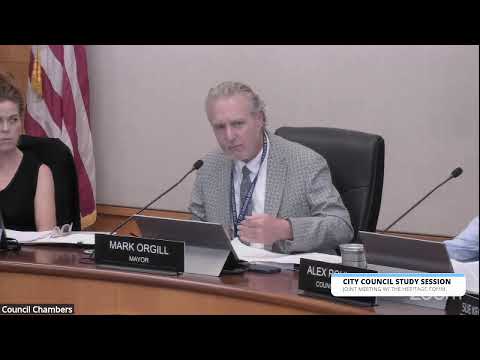
Shweta Sharma of the Community Development Department opened the joint study session by laying out the goals: "Staff is seeking 3 outcomes from today's joint study session," she said — that the council and committee receive the presentation, discuss four policy topics in detail, and give staff direction so a work plan can be developed.
The four topics were: revising how the city administers the Mills Act; studying whether Laguna Beach should pursue Certified Local Government (CLG) status; preparing a historic context statement to guide significance determinations; and evaluating a certificate of appropriateness (COA) permit type and corresponding ordinance.
On the Mills Act, staff told the group the city currently has 142 Mills Act contracts dating to the program’s 1993 adoption. Staff said the contracts run as rolling 10‑year obligations tied to the property, and that the city has not required updated work plans at each renewal or conducted routine monitoring. That gap prompted council questions about enforcement: staff said the contract contains a process to end a contract and reclaim tax benefits, but that active monitoring has been limited; when asked whether the city has ever clawed back benefits, staff answered, "To my knowledge, no."
Council and committee members pressed for practical changes. One councilmember urged requiring a new or updated 10‑year work plan at each renewal and adding audit and inspection mechanisms, and suggested exploring a fee structure so inspections could be funded without general‑fund costs. Consultants and staff proposed possible program fixes — standard application templates, clearly defined eligible and ineligible activities, independent cost review of proposed work plans, required training for applicants, and options for owner self‑certification or periodic inspections.
Consultant Jacqueline Padilla Perez urged clearer homeowner guidance to reduce misunderstandings about allowed uses of Mills Act savings: "I don't think anybody reads them, which is why there's been a lot of misunderstanding of exactly what they can use those property tax savings for," she said, arguing that mandatory applicant training and clearer contract language would increase transparency and defensibility for the city.
The consultants also described other pieces of a preservation framework. A historic context statement, they said, would establish the citywide historical themes, property types, and periods that guide determinations of significance; that document, prepared by qualified professionals and developed through public input, would make future evaluations more consistent and less costly. Staff noted CLG status would make the city eligible for federal preservation grants and training but would require consolidating historic‑resource review authority into a single body — a structural change that merits study. A COA was presented as a discretionary permit that could improve predictability when measured against Secretary of the Interior standards but would require code amendments and careful reconciliation with state housing laws that make some projects ministerial.
On process and timing, staff said they are drafting a general‑plan RFP and could fold a context statement into the larger plan update work. Staff recommended a cautious sequencing: near‑term items that can be advanced with existing resources, with longer‑term items requiring ordinance changes, outside coordination, or additional budget. Staff suggested returning with an update on Mills Act modifications before the program reopens in late January or February and providing more analysis on CLG and COA at a future strategy session if the council requests it.
Participants widely supported a phased approach. Several council and committee members said Mills Act housekeeping — defining eligible activities, requiring updated work plans at renewals, and strengthening audit/inspection practices — should be a near‑term priority, while the historic context statement should be pursued as a foundational document that will guide later implementation tools. No formal action or vote was taken at the study session; staff will return with scope, schedule, cost estimates, and sample ordinances or peer examples for further council consideration.
The meeting then adjourned to closed session.