Get Full Government Meeting Transcripts, Videos, & Alerts Forever!
Get email alerts on the Municipal Budgeting topic
No spam. Unsubscribe anytime.
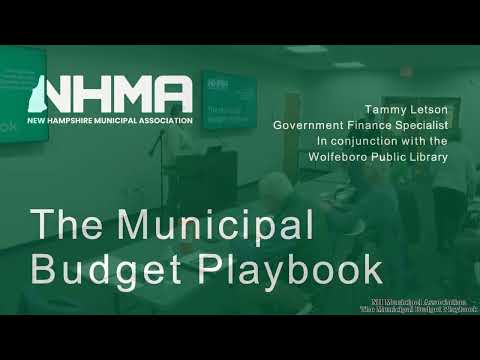
NHMA presenter Tammy briefs Wolfeboro Budget Committee on fund balance, tax basics
Summary
Tammy of the New Hampshire Municipal Association gave a detailed briefing to the Wolfeboro Budget Committee on municipal budget law, fund‑balance categories and limits on fund use, revenue sources, enterprise funds and how local property taxes are calculated. Committee members raised procedural questions about tie votes, equalization and emergency spending.
Tammy, a presenter for the New Hampshire Municipal Association, told the Wolfeboro Budget Committee that municipalities may not spend money unless the law authorizes it and that the Department of Revenue Administration (DRA) supervises many aspects of the process. "One of the ones that I wanna point out... is no spending without an appropriation," she said, summarizing a central legal constraint for local governments.
In a roughly 90‑minute presentation, Tammy walked committee members through key state statutes and accounting rules that shape municipal budgets, including RSA chapter 32 (the Municipal Budget Act), chapter 33 (borrowing rules), chapter 35 (capital reserves) and the DRA rules in RSA 21‑J. She emphasized that DRA can disallow warrant articles that violate statutory limits or exceed the procedural caps towns have adopted: "If you put in a warrant article for the town to do something that is illegal, DRA is going to disallow it," she said.
Tammy explained roles and limits of the three principal players in local budgeting: the legislative body (voters at deliberative sessions and elections), the governing body (the board of selectmen, which is the town’s spending authority here), and the budget committee (which reviews proposals and issues recommendations). She noted that voters at deliberative session can zero out an appropriation or a warrant article — with practical effects: a voter‑approved zero can prevent expenditure of that appropriation for the year.
A substantive portion of the briefing was devoted to fund balance and GASB 54 classifications. Tammy described five fund‑balance categories (non‑spendable, restricted/committed, assigned, and unassigned) and counseled caution about calling unassigned fund balance "cash" or a "slush fund." "There are only 3 ways that that unassigned fund balance can be used," she said, explaining that uses are limited to (1) a legislative‑body appropriation, (2) emergency spending with DRA approval, or (3) to offset taxes.
She warned the committee that emergency use of fund balance is not automatic and requires DRA approval; DRA can and does refuse requests when other funding or reserves exist. Tammy cited an example in which DRA denied a school’s request to use fund balance for a furnace replacement, saying the town should find funds in capital reserves or other sources.
On revenue and tax calculation, Tammy outlined the primary revenue streams (property taxes, motor vehicle registrations, state revenues) and cautioned that grants rarely offset recurring operating costs. She presented local figures as a preview (not final): proposed municipal taxes just under $15,000,000 on a roughly $36,000,000 total budget and noted Wolfeboro’s 2025 municipal rate at about $3.21 per $1,000 of assessed value. She illustrated how the tax rate is derived by subtracting estimated revenues, fund‑balance use and overlays from appropriations to get net municipal tax effort and then dividing by town valuation.
Committee members asked procedural and technical questions — for example how to record tie votes on recommendations and how equalization affects regional school apportionments — and Tammy advised consulting the town attorney for formal tie‑vote recording and stressed the role of equalized valuations in fair apportionment. The session closed with a brief discussion of enterprise funds (water, sewer, electric, ice rink), which Tammy said are intended to be self‑supporting and generally excluded from DRA’s fund‑balance percentage calculation.
No formal actions or votes were recorded during the presentation; the session functioned as an informational briefing ahead of the town’s deliberative and budget processes.