Get Full Government Meeting Transcripts, Videos, & Alerts Forever!
Get email alerts on the Municipal Budget topic
No spam. Unsubscribe anytime.
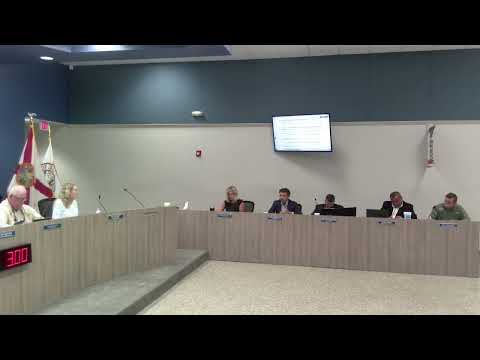
Indian Rocks Beach reviews FY2026–27 budget, plans parking fund to pay for stormwater projects
Summary
City staff presented a proposed FY2026–27 budget and five-year capital improvement plan that holds the millage at 1.73, proposes increases to vacation-rental registration fees, a 4–5% staff cost-of-living increase, and a new paid-parking fund that would transfer roughly $750,000 toward stormwater projects.
City staff on May 18 presented the Indian Rocks Beach proposed FY2026–27 budget and five-year capital improvement plan, saying the draft holds the millage rate steady at 1.73 and maps new revenues to stormwater and infrastructure priorities.
Robin Gomez, the city’s administrative director and acting finance and budget director, told the commission that Pinellas County property appraiser figures show the city’s total taxable assessed value rose about 5.26%—from roughly $2.0 billion to nearly $2.25 billion—producing an estimated $3.775 million in property-tax revenue at a 97% collection rate under the proposed millage.
Gomez also described the creation of a separate paid-parking fund. The city expanded paid parking to include about 204 new spaces at 18th Street and the adjacent county lot, in addition to the existing 76 county-lot spaces. Staff projected FY27 parking revenue near $1.5 million with approximately $1.45 million in expenses; about $750,000 of parking receipts are proposed to be transferred to the capital improvement fund for stormwater and flood-control projects rather than imposing a separate stormwater assessment. “Here’s a resource that now can go towards ticking off those stormwater projects,” Gomez said.
A staff presenter noted the budget reflects priorities developed in the city’s recent strategic-planning sessions—hurricane readiness, a land-development code update, encouraging residential population growth, enforcing ordinances (including short-term rentals and parking), and protecting home rule—and asked the commission to continue review with the Finance and Budget Advisory Board.
On fees and enforcement, staff proposed increasing the vacation-rental registration application fee (the presentation considered multiple levels, including $400–$450 in scenario worksheets) to better cover program costs and compliance work. Commissioners discussed whether a $400 fee would fully cover operating costs; one commissioner cited higher fees in other beach cities as context and urged a larger increase. Staff said the packet’s modeling assumes varying compliance rates and that the sheriff’s calls attributable to rentals are difficult to predict.
Personnel costs were highlighted: staff recommended a 4% or 5% cost-of-living adjustment for city employees (estimated at about $81,000 for 4% and about $92,000 for 5%) and proposed doing a market-rate study within the next 12 months to assess competitiveness. The commission also heard a recommendation to shift the library’s librarian back to full-time and to add an additional code-enforcement officer so two officers could cover Saturday and Sunday enforcement and inspections.
Gomez reviewed contracted services and software proposals: continuing CitizenServe for permitting and the vacation-rental registration workflow, budgeting for cybersecurity services (described as state-mandated), and carrying a $60,000 communications contract with Catalyst Communications into the next fiscal year. He also outlined plans to hire a contractor to review and update the land development regulations, targeting contract availability by Oct. 1.
On the county sheriff contract, staff noted a 6% contract cost increase; the city currently contracts for law enforcement with the Pinellas County Sheriff’s Office and staff said the city can absorb that increase in next year’s budget. For solid waste, staff flagged an ongoing tipping-fee escalation (an annual increase that totals about 8% in recent years) and said the city is issuing an RFP for recycling services to try to contain rates.
Several commissioners asked staff to clarify where the additional code-enforcement FTE appears in departmental schedules; staff said the new position is funded in the parking fund but will be shown in the department-level listings for transparency.
After discussion, a commissioner moved to continue the remainder of the millage discussion to the regular commission meeting opening at 6:00 p.m.; the motion carried on roll-call vote with all voting yes.
The work session recessed for 10 minutes and the remaining millage discussion was continued to the 6:00 p.m. meeting.
Notes: figures in staff presentations are estimates and staff said parking revenue is volatile early in the pilot; staff committed to returning with six-month pilot data and to revisit the parking-fund transfers and any needed ordinance or fee adjustments.