Get Full Government Meeting Transcripts, Videos, & Alerts Forever!
Get email alerts on the Urban Renewal Budget topic
No spam. Unsubscribe anytime.
Hood River URA committee approves FY 2026–27 budget, asks to continue tax division for two districts
Summary
The Hood River Urban Renewal Agency budget committee approved its proposed FY 2026–27 budget and voted to request the maximum tax-division revenue for the Heights and Westside plan areas. The committee kept remaining waterfront funds in contingency while staff proposes a public process to decide final spending.
The Hood River Urban Renewal Agency (URA) budget committee on May 2026 approved the agency’s proposed fiscal year 2026–27 budget and moved to request the maximum revenue that may be raised by dividing taxes for the Heights and Westside plan areas.
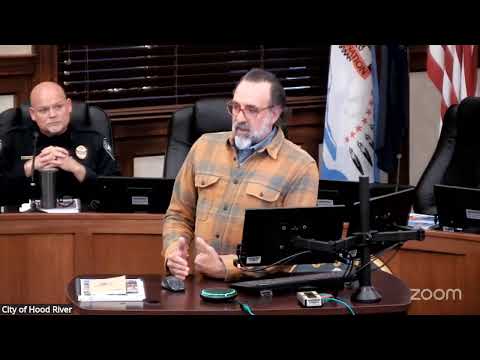
Will (speaker 2), the URA staff presenter, told the committee the agency now manages two active districts — Heights and Westside — after Cascade stopped collecting in 2022 and outlined a conservative revenue forecast based on roughly 3% baseline growth. He said the URA’s finance model depends less on annual tax receipts than on borrowed funds used to catalyze private development, and he summarized remaining authorized indebtedness and cash balances across districts.
The committee discussed options for roughly $1.3 million remaining in the Waterfront district once a stormwater project closes out. Will said resolution 2020-04 dedicated waterfront funds to stormwater work and that the status quo would return the balance to overlapping taxing districts; instead, staff recommended holding the money in contingency and launching a public process to weigh waterfront investments (restroom upgrades, year-round heating, wayfinding, and parking improvements) against returning funds to taxing bodies.
Committee members pressed on timing and constraints for larger projects in the Westside District, where staff identified the Mount Adams roundabout as a key catalyst. Will estimated the roundabout’s full-build cost at about $9.2 million and said the URA could potentially borrow roughly $10 million under a long-term amortization schedule; he cautioned that ODOT approvals and sequential state processes would likely push construction toward 2030.
After public hearing business (no public testimony was registered), the committee moved to approve the proposed FY 2026–27 URA budget. Committee member (speaker 11) made the motion to approve the budget as presented and the motion passed on a voice vote. The same member moved that the Heights District Plan Area and Westside District Plan Area “request the maximum amount of revenue that may be raised by dividing the taxes under section 1(c), Article IX of the Oregon Constitution, and ORS chapter 457 as applicable.” That motion also passed on a voice vote.
The URA budget adopted by the committee keeps most discretionary line items in contingency so decisions about final projects — including whether to retain waterfront funds for local improvements or return them to overlapping taxing districts — can be made through a public process and, if necessary, by the agency board in June.
What’s next: staff will close out the current stormwater project, confirm exact remaining balances, and begin a public engagement process before the agency board considers final allocations; the board can alter committee-approved budget amounts by more than 10% only after renoticing required hearings.