Get Full Government Meeting Transcripts, Videos, & Alerts Forever!
Get email alerts on the Homesteader Credit topic
No spam. Unsubscribe anytime.
Commissioners review homesteader property tax credit, ask staff to study inflation adjustments
Summary
Morgan County staff briefed commissioners on the third year of a homesteader property-tax credit that limits eligibility to residents 65 and older with gross income of $50,000 or less and 25+ years in their home; commissioners asked staff to evaluate tying the income threshold to inflation and to report back.
Morgan County commissioners spent part of a work session reviewing the county's homesteader property‑tax credit and asked staff to return with options for tying eligibility to inflation.
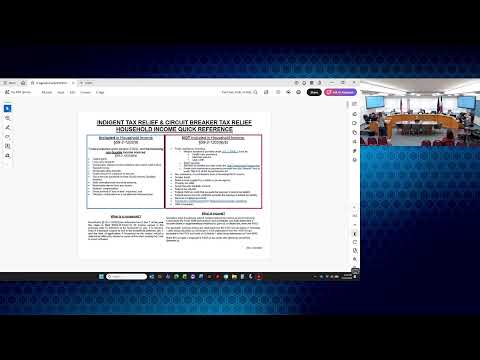
A staff member said the program is in its third year and was created in part to preserve a circuit-breaker‑style benefit for long‑term residents after state changes threatened the existing aid. "This will be the 3rd year we've done homesteader credit," the staff member said, and summarized the eligibility rules: applicants must be 65 or older, have gross household income of $50,000 or less, have lived in the home for at least 25 years, the abated amount applies only to the home's one acre, household income is reviewed, and applicants must have no delinquent county charges.
The staff member noted the legal authority for the program is Utah Code 59‑2‑1347 and that the county modeled benefit mechanics on state circuit-breaker standards: a reduction of 0.5 of tax due up to a maximum (stated in the packet) and a credit equal to tax on 20% of fair market value. The presenter told commissioners that last year the county approved the homesteader abatements for six people and the county's adjusted-off amount was $2,508; packet totals showed broader abatements across several categories (blind abatements, circuit-breaker abatements and homesteader totals) and staff emphasized those figures reflect taxes removed across all taxing entities, not only the county portion.
A commissioner raised concerns that an income-only test could allow households with significant assets to qualify and shift the tax burden to other taxpayers. "You're basically giving away money for the rest of us to pay in the county," the commissioner said. The staff member replied that the county has followed state circuit-breaker standards and so has not included assets in the calculation to date, though the application includes a space to list assets.
Several commissioners suggested the $50,000 income cap should be reviewed for inflation so long-term residents do not lose eligibility as costs rise. Commissioners discussed using the Consumer Price Index or Social Security cost-of-living adjustments as benchmarks; the staff member said they would research inflation‑based options and bring findings back to the full commission rather than scheduling another work session.
Before ending the item, a technical staff speaker clarified a packet reporting anomaly: coding in the county system can show abatement amounts attributed against land lines in reports even though the abatement covered the residential improvement and was credited against the land for reporting purposes.
The commission gave staff direction to examine tying the income threshold to inflation measures and to return with a recommendation.