Get Full Government Meeting Transcripts, Videos, & Alerts Forever!
Get email alerts on the Bond Presentation topic
No spam. Unsubscribe anytime.
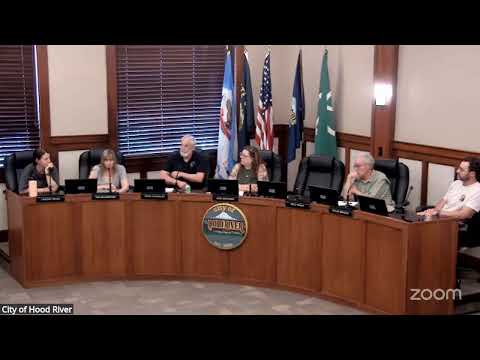
Hood River advisory committee reviews proposed public safety and housing bond measures
Summary
City staff presented two bond options for a new or renovated police facility and outlined how a housing bond could fund land acquisition and development to address an acute shortage of affordable units; committee members pressed staff on timing, costs and political strategy ahead of a July council decision.
Will, a city staff presenter, told the Hood River Urban Renewal Advisory Committee on June 18 that the city is considering a pair of ballot measures for public safety and housing to address long-standing facility shortfalls and an acute housing shortage. "This is our first bond measure that the city's gone for, I think, since 2008," Will said, introducing deficiencies in the existing police facility and a range of housing data.
Will described the police workspace as a basement conversion with seismic vulnerabilities, no backup power, inadequate evidence-processing and interview rooms and unsafe vehicle egress. He outlined two capital options: renovate the basement to provide a more logical footprint and secure evidence functions, or add onto the second floor with an elevator and stairs to accommodate projected staff growth. "Option 1 is renovating the basement of what it should have been renovated in 2011. Option 2 is allowing for the growth of the staff that we're gonna need," Will said.
On housing, Will presented permit and affordability data showing new construction has slowed since 2015 (with a few exceptions such as Adams Creek and Mariposa Village), and that Hood River's ratio of home value to household income rose from about 5:1 in 2012 to roughly 8:1 in 2024. He flagged the largest pipeline gaps at the lowest income bands and said "4 out of 5 Hood River workers live elsewhere and commute into town," driving congestion and labor-supply pressures.
Committee members pressed staff on timing and political strategy. Committee member (S6) recommended waiting until Mariposa Village is fully occupied and operating before advancing a separate housing bond so the city could point to an operational track record. "I personally think that it would be a really good idea to wait until that project is completed and that you as a city can tell that we have a fully operational... we have filled it up," the member said. Other members expressed concern about voter fatigue after recent measures but acknowledged the long lead time required to produce housing.
Will presented preliminary cost scenarios for the police options and the housing measure. He estimated a base police renovation could generate roughly $6.7 million (about $6.06 per month for the median property taxpayer under his model) and an expanded option near $8.7 million (roughly $7.88/month median). Using a Metro-style tax rate would produce approximately $4.8 million (about $4.36/month), while a Portland-style rate could generate an estimated $8.5 million; Will cautioned these were preliminary and would be rerun when the ballot title is finalized.
Will said survey responses so far lean toward placing the police and housing requests as two separate ballot measures, and he outlined public outreach: a housing bond town hall on June 23 and a police-station open house on June 29, followed by one more round of polling and a July city council decision on what, if anything, to forward to the November ballot. "We'll take all this input, all the survey responses, all the polling to city council, and it will be for them to finalize the ballot title and decide what to forward to the November ballot in July," he said.
Why it matters: the measures would expand city capital capacity to acquire land and build or renovate a police facility and affordable housing, potentially changing the city's role in housing development. The committee's discussion highlighted three political and programmatic risks: (1) timing vs. voter appetite, (2) the ability of a small city to acquire and steward land at scale, and (3) how much control the city can exert in development without substantial capital contribution.
What's next: staff will continue outreach, rerun cost estimates when the ballot title is drafted, hold the June 23 and June 29 events, and present a recommendation to council in late July. The committee did not take a final vote on forwarding measures.