Get Full Government Meeting Transcripts, Videos, & Alerts Forever!
Get email alerts on the Agriculture topic
No spam. Unsubscribe anytime.
Committee member urges larger supplemental aid as witness points to trade deals and big rural investment
Summary
A member of the Senate Committee on Agriculture, Nutrition, and Forestry said supplement payments help keep farms afloat but may need to increase; a witness pointed to lower input costs, new trade deals, biofuels policy and a claimed $250 billion rural investment as longer-term fixes.
A member of the Senate Committee on Agriculture, Nutrition, and Forestry warned at a hearing that the U.S. farming sector faces a "generational crisis," saying, "We're gonna lose 25% of our farmers in the next 2 or 3 years," and urged consideration of larger supplemental aid to help producers weather the downturn.
The committee member said the current supplemental assistance is "very much appreciated" but "not the answer," and asked the witness to outline policies to reduce future need for such support, naming fertilizer costs, E15 biofuel expansion and efforts to add value and find new export markets.
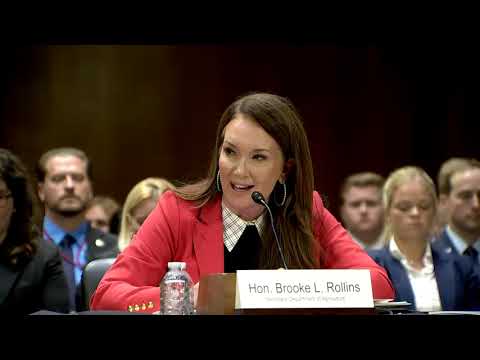
The witness responding at the hearing agreed that lowering the cost of inputs should be the primary focus, listing fertilizer, seed, labor and interest rates as key drivers. "If we can just get inputs back down to where they were in Trump 1, we're gonna have a remarkable recovery in farm country," the witness said.
The witness also cited expanded markets, saying 19 new trade deals and a strengthened renewable fuel standard have helped push commodity prices higher this year. "We're already seeing corn and wheat hit record highs or the highest number for the year after announcing the new renewable fuel standard," the witness said, attributing part of the recovery to export growth and biofuels demand.
Pointing to fiscal and price-support changes, the witness credited the Working Families Tax Cut Act and said reference prices were being increased "for the first time in more than a decade," and described what he called a $250,000,000,000 investment in rural America as the largest such commitment in U.S. history. He framed those measures, along with trade and biofuels, as factors that could change the sector's long-term trajectory.
Both participants emphasized the role of short-term supplemental assistance while longer-term policies and market shifts take effect. The committee member said the size of the supplemental may need "bumping up a little bit" after the day's testimony; the witness reiterated that the supplemental remains "very, very important" to bridge to longer-term recovery.
The hearing continued with additional testimony and discussion following these exchanges.