Get Full Government Meeting Transcripts, Videos, & Alerts Forever!
Get email alerts on the Bailiff Operations topic
No spam. Unsubscribe anytime.
Walker County moves to formalize bailiff duties with draft contract after judges raise safety concerns
Summary
Commissioners agreed to circulate a draft contract formalizing bailiff duties and stipend terms after judges raised safety concerns about constable courtroom performance; commissioners favored a short-term stipend solution while reserving a six-month review and GA review before possible adoption.
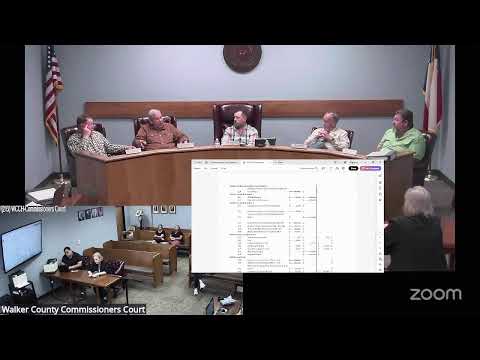
Walker County Commissioners Court on July 20 directed staff to circulate a draft contract that would formalize courthouse bailiff duties and stipends after district judges raised safety concerns about courtroom security and constable performance.
A court member read a letter from a district judge detailing “completely unacceptable” lapses, including “using your phone while in the courtroom” and instances of sleeping on duty, and noted occasions when courtrooms were not properly locked, raising questions about the ability to maintain courtroom safety. The letter was cited by a commissioner during the session as evidence that the court needs an enforceable agreement to secure proceedings.
Miss Bradley, a member of the public who addressed the court during public comment, said the county has “an obligation to the citizens of this county to have our courtrooms that are secure,” referencing a previous incident when a person was able to carry a gun into the courthouse and later shot himself in a bathroom. "We want our courtrooms to be secure," she said, urging cooperation among judges, constables and county leadership.
Commissioner Bill summarized a facilitated meeting among district judges, constables and the sheriff that explored three options: keep constables as bailiffs with revised expectations; reassign or remove constable bailiff duties from some precincts; or fund dedicated bailiffs through the tax rolls. Bill said the group favored keeping constables as a short‑term fix if the court can document expectations and provide oversight.
To avoid a large tax increase, Bill proposed increasing the existing stipend for constables who serve as bailiffs from roughly 4 hours per week to 8 hours per week, estimating a total supplemental cost of about $64,000 (about $16,500 each if divided evenly among four constables) versus an estimated $275,000 annual cost to place dedicated bailiffs on the tax roll. "That's a generous nice offer," he said, describing the stipend increase as a short‑term measure to stabilize coverage.
The draft contract discussed would be created by the commissioners court (rather than the district judges) with a line for the sheriff to sign off, acknowledging the sheriff’s role in courthouse security. Commissioners debated whether the contract should allow a constable to send a deputy to the courthouse to fulfill bailiff duties without additional pay; some said allowing deputies undermines an elected official's authority, while others said the court must be able to enforce standards for whichever officer is acting as bailiff.
The court agreed to collect comments from involved parties, send the draft to the county general administration (GA) office for review, and return the item to the next court meeting with a resolution for possible adoption. Language will include a requirement that any party wishing to discontinue the arrangement notify the court in January and that the court review the arrangement after six months to determine whether to extend or pursue longer‑term options.