Get Full Government Meeting Transcripts, Videos, & Alerts Forever!
Get email alerts on the Transportation topic
No spam. Unsubscribe anytime.
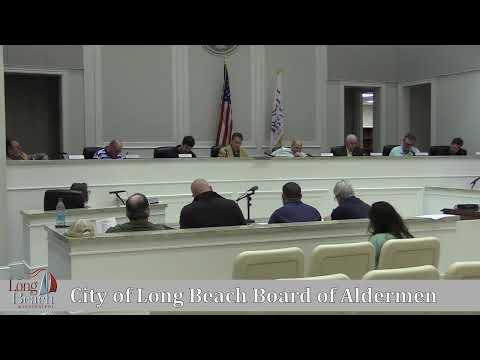
Long Beach board asks regional planners for traffic study before lowering Castine Point speed limit
Summary
After constituent requests to cut the Castine Point speed limit, the board unanimously directed staff to request a traffic study from the Gulf Regional Planning Commission and to consult police crash data before changing posted limits.
Alderman Peake asked the Long Beach Board of Aldermen to consider reducing the Castine Point speed limit after hearing requests from residents; the board instead approved a motion to ask the Gulf Regional Planning Commission (or similar regional body) to perform a traffic study before any speed-limit change.
"I polled about 7 or 8 individuals who live in Castine Point... every one of them... would prefer the speed limit be reduced to 20 miles an hour," Alderman Peake (speaker 7) said, describing constituent pressure and his change of view after further reflection.
Allen Weatherford (speaker 12), a former Gulfport police chief who said he has worked traffic enforcement and studies, urged the board not to "spot reduce" speed limits without a comprehensive traffic study that accounts for road characteristics, traffic flows and enforcement. "I'm asking y'all before you start reducing the speed limit signs ... to do a comprehensive traffic study," Weatherford said, warning that an artificially low posted limit can be perceived as a speed trap.
Board members responded that they appreciated Weatherford's technical advice and that the city has access to regional planning resources and grant funds that could help pay for targeted studies. Alderman Peake amended his original motion to ask the regional commission to evaluate Castine Point and to provide a study rather than immediately change posted speeds; the board approved the amended motion.
The action records direction to seek an expert traffic study and to consult the police department's crash and enforcement data before posting any new limits. That approach leaves any future speed limit change contingent on engineering and enforcement findings rather than an immediate posting change.
What happens next: Staff will reach out to the regional planning commission to request a study and gather police crash/enforcement data; the board will consider the study's recommendations before voting on any change to posted limits.