Get Full Government Meeting Transcripts, Videos, & Alerts Forever!
Get email alerts on the Municipal Budget topic
No spam. Unsubscribe anytime.
East Hampton council approves revised town and school budgets after residents protest preschool and athletics cuts
Summary
The East Hampton Town Council voted to place revised general government and Board of Education budgets on the August referendum after dozens of residents criticized cuts that eliminate the Smart Start preschool and middle school athletics; the council debated using surplus funds and a proposed transfer-station change.
The East Hampton Town Council approved revised general government and Board of Education budgets on July 22 and set a town meeting for July 29 and a referendum for Aug. 5.
Chair opened the special meeting and the council voted to send the general government budget of $19,358,960 to the referendum and later approved a revised Board of Education budget of $39,550,937. The Board of Finance had recommended reductions that together reduced the most recent failed iteration by $690,949 and proposed using roughly $600,000 of FY26 revenues to offset capital transfers.
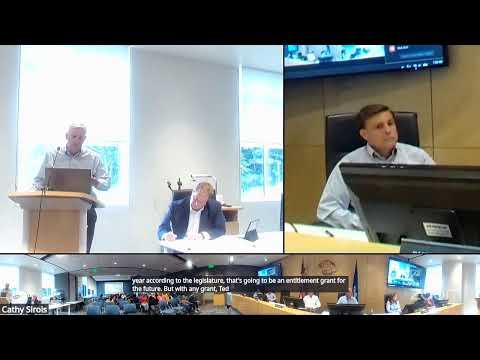
The decisions followed a lengthy public-comment period in which residents raised alarms about program cuts, communication failures and fiscal choices. Neil Henrickson, a resident on Terp Road, urged that his tax dollars “not be used for property tax assessments,” and other speakers pressed the council on why preschool and middle school athletic programs would be cut.
"Why is the town foregoing nearly a $150,000 in identified revenue while children lose access to an early education?" Shelby Galvin, a parent and taxpayer, asked, referencing a $97,000 grant and a potential $45,000 sliding-scale tuition that the school district identified. Hailey Guy, another parent, said the cost to preserve programs had been described to residents as roughly "$5.50 a month," and asked what the average homeowner actually saves under the proposed mill rate.
A school official who addressed the council explained the financial and program details: the Smart Start program carried an estimated $97,000 grant and two full-time-equivalent staff positions, with salaries and benefits for the program totaling roughly $204,000; sliding-scale tuition might produce about $45,000 but was not guaranteed. The official said program capacity was 18 students and that some staff reductions could be offset by vacancies elsewhere, but added that grant funding is not certain year to year.
Council members also debated municipal service reductions and the use of the town's fund balance. One council member objected to what they described as moving more money out of savings to buy down the budget after voters had rejected prior iterations, and warned that closing the town transfer station and contracting services without bids or public input would be a significant policy shift. Other members said the Board of Finance had sought ways to save money and that, at their meeting, no public speaker had opposed the transfer-station recommendation.
The general government budget vote was recorded in the meeting as a tally of “5 1 0 2” (noted in minutes as yes=5, no=1, abstain=0, absent=2). The revised Board of Education budget was approved by voice vote; no roll-call tally was recorded in the transcript.
The council set the town meeting for Wednesday, July 29 at 3:30 p.m. and scheduled the budget referendum for Wednesday, Aug. 5, 2026, from 6 a.m. to 8 p.m. at Town Hall. The meeting adjourned to referendum; council members emphasized that the town meeting is a formality and that the referendum will determine final approval.
The council and the school official acknowledged shortcomings in outreach and communication; residents asked for clearer, earlier notice and alternative options (such as sliding-scale tuition) before program confirmations were mailed. The school official said the district's communications are constrained by referendum-related legal limits and that the district would pursue broader discussion about community-wide notification systems.
Next steps: the budgets will appear on the Aug. 5 referendum ballot. If approved by voters, the decisions will take effect according to the town's budget calendar; if not approved, council members discussed options for additional adjustments or appropriations at a later date.