Get Full Government Meeting Transcripts, Videos, & Alerts Forever!
Get email alerts on the Land Use topic
No spam. Unsubscribe anytime.
Charlestown advisory commission approves Clever data center with conditions after tense public hearing; recommends moratorium to council
Summary
After hours of public comment raising noise, water and safety concerns, the Charlestown Advisory Plan Commission voted 4-3 to accept the building commissioner's recommendation to approve Clever's 55,000-square-foot data center with binding conditions and asked the city council to consider a one-year moratorium on new data-center applications.
The Charlestown Advisory Plan Commission on Monday heard more than two hours of public comment before approving, by a 4-3 margin, a building-commissioner recommendation to permit developer Clever's proposed 55,000-square-foot, single-story data center with a package of binding conditions.
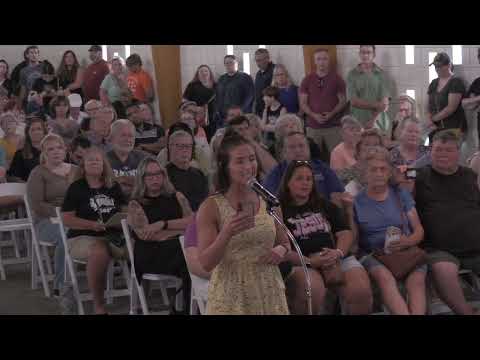
The decision followed a packed public hearing during which dozens of residents urged the commission to slow the process, demand independent studies and require enforceable protections for nearby neighborhoods. "This is a neighborhood. This is where families live, children play, and people have invested their life savings," said resident Jordan Flaherty, whose home is about 100 feet from the proposed site. "We are asking the questions. Public service comes with accountability."
The developer, represented by Kevin Nordstrom, told the commission the facility is a "networking data center," not an AI campus, and said it would be single-story and limited in scale. Nordstrom said the firm expects roughly $90 million in construction spending, about 200 construction jobs over 12'18 months, and that after an initial closed-loop cooling fill of about 60,000'70,000 gallons the system would use roughly 200'300 gallons per day. "We have a commitment with REMC," Nordstrom said, and the developer said it would pay for required substation upgrades.
Many speakers disputed the assurances. Residents cited potential noise from cooling equipment and backup generators, possible water and wastewater impacts, emergency-response challenges for electrical or battery fires, and harms to property values and wildlife. Several asked for an independent, third-party review of long-term noise (including low-frequency/tonal effects), water impacts and cumulative environmental effects, including possible impacts on the federally endangered Indiana bat.
The commission and developer addressed several specific mitigation measures during board Q&A. The developer agreed to build landscaped berms and plant irrigated, native evergreen trees for year-round screening; to orient the building and locate mechanical equipment to maximize distance from nearby homes; to provide post-construction and regular wastewater testing before discharge to the city system; to offer training and tours for local police and fire departments; and to commit to pre- and post-blasting surveys to help document any construction-related damage.
Commissioners also debated whether a modern, 3'5 megawatt data center fits Charlestown's light-industrial (L1) zoning, which the town's code defines to favor enclosed operations that do not produce offsite nuisance emissions. The building commissioner had concluded the proposal met existing code standards; several commissioners said their legal duty required them to decide whether the application met those standards.
A motion to adopt the building commissioner's recommendation carried on a 4-3 voice/hand count, with commissioners recording four votes in favor and three opposed. The approval included the developer commitments noted above: a single building only, binding and irrigated berms and plantings, pre- and periodic post-construction water testing, emergency-response coordination and training, dimmed and shielded lighting, pre- and post-blast property surveys, and a requirement that the developer pay for required electrical upgrades rather than shifting those costs to ratepayers.
Separately, the commission voted to recommend that the Charlestown City Council consider a one-year moratorium on new data-center applications to allow the city time to evaluate cumulative impacts and consider zoning updates; that motion was forwarded to the council by voice vote.
What happens next: the commission's approval is a land-use decision based on the town's zoning code; the planning documents and the developer's proposed conditions will be incorporated into final approvals and any contract or covenant language. The moratorium recommendation goes to the city council for consideration.
In their closing remarks, several residents urged elected officials to prioritize long-term community protections over short-term development gains. "The developer will not live with the noise. The residents will," Jordan Flaherty said. "We will remember who listened."