Get Full Government Meeting Transcripts, Videos, & Alerts Forever!
Get email alerts on the Community Planning Fellowship topic
No spam. Unsubscribe anytime.
Fund for the City of New York details Community Planning Fellowship, invites Bronx board proposals (deadline Sept. 9)
Summary
Fund for the City of New York described its Community Planning Fellowship — a competitive two‑semester placement for graduate students who provide data, mapping and research to community boards — and urged Bronx boards to submit proposals by Sept. 9.
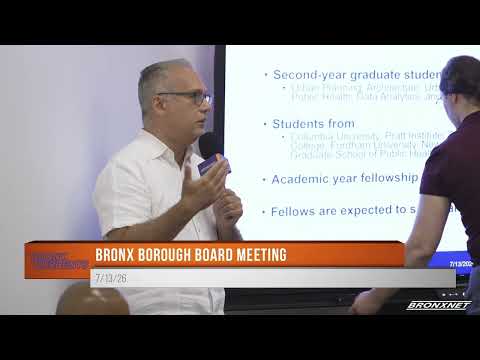
The Fund for the City of New York outlined a Community Planning Fellowship program that places second‑year graduate students in community boards to help with research, mapping and resolution drafting, a presenter told the Bronx Borough Board meeting.
Dr. Algen Rafael Munilla, executive vice president, said the fellowship is highly competitive and pairs fellows' academic work with board projects such as soft‑site mapping, demographic analysis and quality‑of‑life data visualization. “We also are really known for doing over a $150,000,000 a year in bridge financing, at no fees, no interest to nonprofits,” Munilla said, describing other Fund activities that support neighborhood organizations.
Why it matters: community boards often need technical capacity—data analysis, land‑use mapping, or outreach planning—that volunteers and unpaid members cannot provide. The fellowship offers supervised student labor plus a curriculum of roughly 30 trainings, Munilla said, including 15 core community‑board competency sessions (resolution writing, land use basics, FOIL, conflicts‑of‑interest training).
Munilla and Steven Mendivenso, coordinator of the Community Planning Fellowship program, said applicants can propose up to two projects and that fellows are matched by academic focus and skills. Examples offered to the board included mapping streetlight complaints, catch‑basin flood mitigation sites, privately owned public spaces, public restroom availability and neighborhood‑specific affordable‑housing models.
Board members asked whether fellows can support advocacy as well as mapping. Munilla said projects must contain an academic research component but can be written to include stakeholder interviews and strategic outreach that inform advocacy. He also confirmed a proposal deadline of Sept. 9 and said interested boards should submit proposals via the program website (www.fcny.org).
The Fund presenters said districts should name the staff or board member who will guide and meet regularly with the fellow; fellows are expected to coordinate with a local subject‑matter expert and meet with supervising board leadership at least weekly or biweekly. The presenters also encouraged reuse or continuation of prior fellows’ work when practical.
Next steps: the Fund will circulate the presentation materials to board leadership, and board members were encouraged to discuss project ideas with district managers and submit proposals ahead of the Sept. 9 deadline.