Get Full Government Meeting Transcripts, Videos, & Alerts Forever!
Get email alerts on the HR1 Eligibility topic
No spam. Unsubscribe anytime.
HR 1 will narrow noncitizen full Medicaid coverage and add work requirements for expansion population, state says
Summary
Department for Medicaid Services officials said federal HR 1 changes will restrict some noncitizen full-coverage eligibility effective Oct. 1, 2026, and that new community engagement/work reporting for the expansion population begins Jan. 1, 2027; the department sent outreach notices to roughly 373,915 households and issued about 9,500 RFIs to cases it could not verify.
Veronica Judy Cecil, senior deputy commissioner at the Department for Medicaid Services, described two major federal changes under HR 1 that the department is implementing.
On noncitizen eligibility, Cecil said states must reverify immigration status and that Kentucky ran federal data checks and issued roughly 9,500 requests for information between June 5 and June 14 to members whose status could not be verified. She said the rule will limit which immigration statuses qualify for full Medicaid coverage effective Oct. 1, 2026 and that some groups (lawfully residing pregnant women and children, lawful permanent residents who meet or are exempt from the five-year requirement, Cuban/Haitian entrants and Compact of Free Association migrants) will still qualify for full coverage in Kentucky. She warned that those the state cannot verify will be disenrolled effective Sept. 30 and that time-limited emergency Medicaid remains available for life‑threatening conditions.
"There is no exception or exemption to this federal requirement," Cecil said, adding that affected individuals must respond to RFIs and that connectors are available to help.
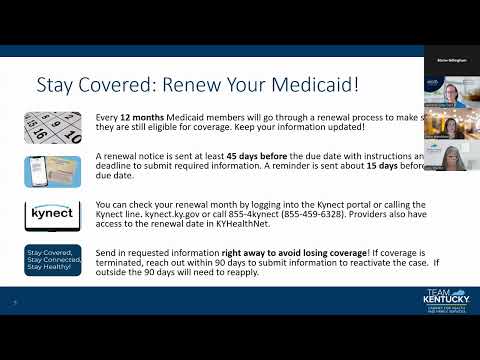
Cecil also summarized the state implementation of HR 1's community engagement (work) requirement for the Medicaid expansion population. Starting Jan. 1, 2027, newly enrolling expansion members must demonstrate compliance or an exemption. Current enrollees will be subject to the requirement at their next renewal; the first renewals subject to the requirement are February 2027 renewals because renewal processing begins 60 days in advance. Cecil said the state sent outreach notices on July 1 to about 373,915 households (431,731 individuals in those households) to educate members about the changes and explained the state will provide forms and multiple communications to help members document compliance or exemptions.
David Berry (Medicaid) added a marketplace note: people receiving advanced premium tax credits (APTC) could still buy full-price marketplace plans but will lose APTC beginning Jan. 2027; the department is removing affected individuals from automatic renewal to avoid inadvertent enrollment in costly plans and said those people will need to shop for coverage like new enrollees.
The department directed members with RFIs or questions to connectors and the department website for detailed guidance and document lists; it said CMS guidance and a department table are posted to help members understand who is affected.