Get Full Government Meeting Transcripts, Videos, & Alerts Forever!
Get email alerts on the Recycling Contracts topic
No spam. Unsubscribe anytime.
New recycling processing contracts lower costs, boost market value for Nashville materials
Summary
City staff reported improved service KPIs and a new one-year processing arrangement with Waste Connections and WestRock that reduced processing fees from $150/ton to $57.50/ton and increased market value for glass, paper and cardboard, officials said.
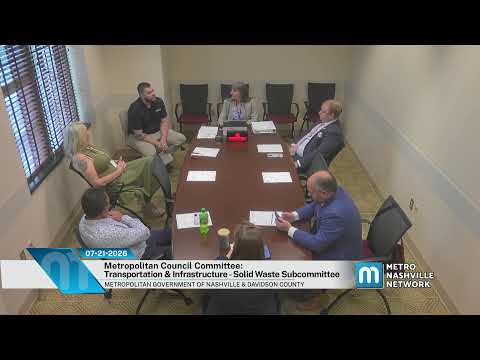
Matt Purvis, accounts liaison for National Way Services, told the Transportation and Infrastructure Solid Waste Subcommittee that recent changes to recycling processing have sharply reduced the city’s processing costs and clarified where recyclable materials are being sold.
Purvis said the city moved from a local Waste Management processing facility to a one-year purchase order with Waste Connections and WestRock, with recyclables routed through a processing facility in Chattanooga. Processing fees fell from about $150 per ton under the prior arrangement to $57.50 per ton under the new arrangement, he said, and markets for material have improved.
“Net net increase, we’re getting a $115 a ton more for our glass,” Purvis said, and added the city is now making roughly $30 a ton on glass after the change. He also reported $45 more per ton for cardboard and about $58 more per ton for paper, with paper and cardboard processed by WestRock and ultimately shipped to a paper mill in Alabama.
The subcommittee also heard performance metrics: Purvis reported a combined service rate for three trash haulers of roughly 99.7% and a recycling service rate near 99.7%. He said the system serves roughly 146,000 weekly trash customers and that daily missed-stop averages in recent reporting were on the order of 100 trash stops and 35 recycling stops per day — a small percentage of total stops but significant for affected residents. The city’s internal goal is to return to missed stops within 24 business hours; typical contractor turnaround averages two to three days, Purvis said.
Committee members urged clearer public messaging about where recyclables go to combat skepticism that “it just goes in the trash.” Purvis said the materials were fresh from recent communications and staff would prepare clearer materials for public distribution.
The subcommittee also discussed ongoing waste characterization work: staff completed four seasonal waste-audit polls to better target diversion strategies, including organics and construction-and-demolition (C&D) materials, and said the existing 0-waste master plan could be updated based on the new characterization.
The subcommittee did not take a formal vote on these operational items; staff said they will follow up with clearer public outreach materials and more detailed waste-audit findings at a future meeting.