Get Full Government Meeting Transcripts, Videos, & Alerts Forever!
Get email alerts on the Land Development Code Rewrite topic
No spam. Unsubscribe anytime.
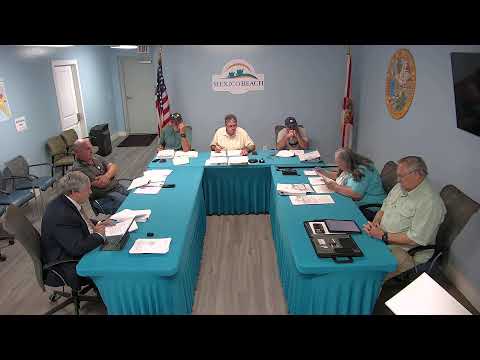
Mexico Beach Planning board debates major land-development code rewrite, residents press for notice and environmental limits
Summary
The Planning & Zoning Board reviewed extensive rewrites to Mexico Beach's land-development code — renumbering articles and consolidating review categories — and heard residents warn the changes could limit public notice for canal projects, weaken environmental protections for junkyards, and leave stormwater and lodging rules unclear.
The Mexico Beach Planning & Zoning Board on Tuesday reviewed a sweeping rewrite of the city's land-development code that renumbers chapters, consolidates development-review categories and updates rules on nonconforming structures, waterfront work, RV and mobile-home parks, stormwater and junkyards.
Planner Laura presented the package, saying the document largely reflects prior board discussion and statutory changes adopted at the state level. "The red font is the new language or the changes from the last meeting," she said, and noted small wording edits such as changing references to "septic tanks" to "wastewater." The draft also collapses several previous review types into three categories: administrative, minor and major review.
Why it matters: Board members and residents said those structural changes could reduce opportunities for neighbors and the public to weigh in on projects near canals and on other waterfront work. "If these things are now to be approved by the administrator, then the people on the surrounding property, the neighbors, have no way of knowing that any of these developments are going to be done," one committee member said. Planner Laura responded that many water-dependent structures are captured by the administrative review category and that the code language will be clarified to reflect which items are administrative versus quasi-judicial.
Key points and disputes: - Nonconforming structures: The draft originally included a post-hurricane three-year rebuild allowance for legally nonconforming nonresidential structures; board members questioned why that exception would remain. Planner Laura and others recalled the three-year clause as a Hurricane Michael-era exception; the board directed the drafter to end the sentence at "in perpetuity" and remove the three-year rebuild window so that larger rebuild exceptions would be handled by other existing provisions (including the typical 50% fair-market-value threshold for required compliance).
- Canal projects and seawalls: Residents and multiple board members pushed back on language that places many docks, boathouses and seawalls within administrative review (handled by the Mexico Beach Building Department). "The council has always approved what is built on the canal," a member said. The planner said the language as drafted reflects where the activity falls in the new category framework but agreed to add clarifying text outlining when canal-related work will be taken to a quasi-judicial hearing.
- Wastewater and level-of-service formulas: A board member asked why a wastewater incremental-demand formula was removed while water formulas remained. Planner Laura said the wastewater treatment metric is tied to the comprehensive plan's level-of-service standard (90% of projected potable water use) and that detailed calculations are applied during subdivision or development-order review rather than repeated in the high-level development standards meant for applicants.
- RV parks and park models: The draft reduces the minimum acreage for RV parks from 8 to 5 acres to match existing facilities. The board debated whether park trailers and "park models" should be treated as recreational vehicles subject to a 180-day occupancy limit or whether some park-models or modular units should be permitted as longer-term units; staff cited Florida statutory definitions and proposed consolidating the terminology under the RV definition with occupancy limits applied as appropriate.
- Junkyards: The proposed code would allow junkyards in limited general-commercial zones provided they are screened, do not front major roadways (Highway 98 or 15th Street), and meet nuisance and environmental protections. Public commenter John Harrell said permitting junkyards in any location conflicts with the city's comprehensive-plan image as a beach community and urged strict environmental safeguards (setbacks from waterways, impermeable pads, and control of leaks from vehicles and batteries). Staff said the restrictions are intended to limit visual and environmental impacts and to make the regulation defensible under state law.
- Mobile, manufactured and modular homes: Board members discussed how state law is changing treatment of factory-built housing. Staff noted that, beginning Jan. 1, 2027, Florida will require local governments to allow modular and manufactured homes in any zoning district where single-family detached homes are allowed; local governments may retain uniform design standards but cannot treat factory-built homes more restrictively than site-built homes. The board asked staff to analyze whether to retain, amend or remove local mobile-home-park language in light of that upcoming preemption.
- Stormwater: Several residents urged stricter controls for single-family rebuilding and additions that raise lot elevations and cause runoff onto neighbors' yards. Planner Laura said the expectation is that platted subdivisions account for stormwater at the planning stage but agreed to consult a stormwater engineer and consider adding text preventing single-family improvements that intentionally discharge stormwater offsite.
What the board decided and next steps: The board recorded agreement on several drafting points and asked staff to clarify (1) which water-dependent features will require quasi-judicial review, (2) precise thresholds distinguishing administrative versus minor reviews (including square-foot thresholds for impervious surface), (3) environmental protections and setbacks for junkyards, and (4) stormwater enforcement language and public-notice options for items handled administratively. Staff will return with a consolidated packet for further review and referral to the City Council.
Quotations: - "I am very unhappy with the way this has been redefined," a committee member said about collapsing review categories into three, adding that the change "strips the protection for the city out of what already exists." (Committee member) - "If these things are now to be approved by the administrator, then the people on the surrounding property, the neighbors, have no way of knowing that any of these developments are going to be done," a resident-style commenter said during discussion of canal approvals. (Committee member) - "Does this not directly conflict with our comprehensive plan about a beach community?" public commenter John Harrell asked about the junkyard allowance; he said a junkyard "goes completely against what is in our comprehensive plan." (John Harrell, resident)
The board did not take final legislative action on the overall package; staff will revise the draft to reflect the clarifications requested and return it for further board consideration and potential referral to City Council.