Get Full Government Meeting Transcripts, Videos, & Alerts Forever!
Get email alerts on the Capital Punishment topic
No spam. Unsubscribe anytime.
Attorney General Coleman urges governor to sign death warrants, seeks court action to dissolve injunction
Summary
Kentucky Attorney General Coleman said after oral argument in Franklin Circuit Court that his office is asking the court to dismiss a 2010 temporary injunction so roughly a dozen death-row inmates could receive their sentences and families could obtain long-delayed justice.
Attorney General Coleman called on Governor Beshear to sign death warrants and asked the Franklin Circuit Court to dismiss a 2010 temporary injunction that his office says prevents executions in related cases.
Coleman told reporters after oral argument that the litigation over the cases has dragged on for 20 years and that dismissing the civil case would "pave the way for around a dozen death row inmates to finally receive their sentence." He described the delay as a failure to deliver justice to surviving families and said the Commonwealth has a duty to enforce jury sentences.
"It's time for justice to come for Caroo White," Coleman said, also naming Benny Hodge and Samuel Fields as inmates he said had received lawful sentences from juries. He cited the 1992 ambush that killed Powell County Sheriff Steve Bennett and Deputy Arthur Briscoe as a reason families continue to seek closure.
Coleman said the so-called temporary injunction entered in 2010 "doesn't actually apply" to the case involving Ralph Baze and urged the governor that "he needs no new law" or regulation to sign a death warrant. "He can do it today," Coleman said, calling arguments that the state lacks necessary steps or authority a "straw dog."
Jack Hayburn, principal deputy solicitor general for the Attorney General's Office, told reporters the office's motion, if granted, "would remove all doubt" about legal impediments and could result in orders allowing death warrants to proceed for individuals in the related cases, though he cautioned precise effects would depend on the judge's order.
Coleman also responded to a reporter's question about the governor's claim that lethal-injection drugs were unavailable, saying the Justice Department and Federal Bureau of Prisons have been contacted to assist states in obtaining medications, and pointing to recent executions in neighboring Indiana as proof that states have been able to secure required compounds.
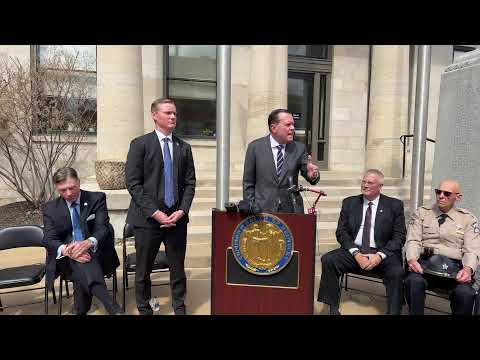
A lead Kentucky State Police detective, Lieutenant Bobby Motley, recounted the investigation and trial in 1992, saying the defendant was convicted after a three-week trial and that juries imposed death sentences in those cases. Senator Brandon Smith and Lewis County Sheriff Johnny Bivens spoke at the event in support of the Attorney General and the families.
Coleman described the next step as a ruling from Judge Shepherd of Franklin Circuit Court and said his office looks forward to a decision; the court's action was not announced at the press event. The Attorney General offered to provide reporters with cost figures for the litigation later but emphasized the human and rule-of-law impacts of decades of delay.
The press conference closed with no immediate executive action; any issuance of death warrants would require the governor's signature and could be affected by subsequent court rulings or administrative steps.