Get Full Government Meeting Transcripts, Videos, & Alerts Forever!
Get email alerts on the Stormwater Flooding topic
No spam. Unsubscribe anytime.
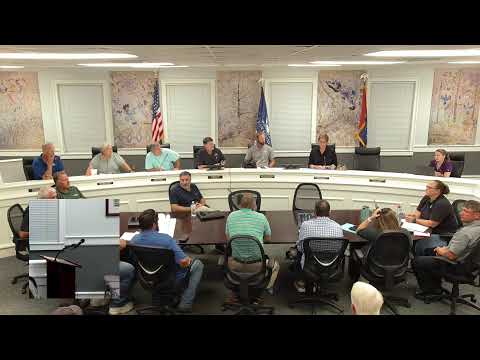
Ocean Springs aldermen hold Ward 6 flooding work session, urge grants and engineer studies; no formal action taken
Summary
Ocean Springs aldermen met in a work session to address recurring flooding and drainage complaints in Ward 6, heard engineers and public-works staff outline short-term fixes and long-term constraints, and agreed to pursue grant funding and engineering plans; no formal votes or policy actions were taken.
The Ocean Springs Board of Aldermen convened a work session to discuss persistent flooding and drainage problems in Ward 6 and to identify short-term fixes and longer-term planning needs; the meeting, presided over by the Chair, produced no formal actions. The chair opened the session by noting that the meeting was a work session and that "no official action will be taken." The alderman leading the discussion framed the problem as recurring and underscored that "I'd rather be proactive than reactive," urging a plan that pairs immediate maintenance with engineering studies and grant-seeking.
Board members and staff described a two-track approach: have public-works crews continue targeted maintenance while the city pursues outside engineering studies and funding. A public-works staff member said recent small interventions — replacing covers, cutting ditches and adding short culverts — produced measurable improvements at specific corners and cautioned that some recommended county-study measures (such as widespread piping) may be unnecessary in places where rock-lined open ditches move more water: "open ditch take more water than pipe ditch," the staff member said.
A consulting engineer advised the board that the morning's rainfall resembled a multi-year storm and that the city's design standard for new subdivisions is a 25-year storm event; he warned many older culverts and pipes were built to far smaller standards and called the work to fix downstream choke points "expensive to fix." He urged the board to develop a prioritized plan so the city can seek grants and federal or state funds rather than reacting project by project.
Members discussed use of an existing county study covering Olmos/annexed areas as a starting point to avoid duplicative work, noting some county recommendations carry multi-million-dollar price tags for full implementation. One board member asked where annexation tax revenue for the more than 1,000 annexed residents would be applied; a colleague said the 2026 tax roll will allow the city to budget for such needs and recommended drainage be a priority in the coming budget cycle.
City planning staff and board members also discussed wetlands mitigation, the Unified Development Code green-space requirement (noting a 20% green-space rule), and limits on local control over federal wetland classifications. Planning staff said some standing-water issues are driven by bayou levels, beaver activity and elevation constraints, factors that local engineering can mitigate only so far.
On operations, public works estimated it would take its small crew roughly a month or longer to clear easements in the most affected neighborhoods if the crew were focused on those tasks, and staff noted clearing easements can be complicated when individual homeowners decline right-of-entry. Public-works staff described a near-term work plan that includes changing out covers on parts of Plymouth within about three weeks and continuing ditch work on Burbank and adjacent streets.
The board agreed on next steps without taking formal action: use the county study to pursue funding, have staff request engineer proposals to develop a prioritized, costed plan, schedule comp-plan work sessions to fold drainage policy into land-use planning, and include drainage needs in the upcoming budget review. The meeting concluded with the Chair thanking participants and closing the work session.
The session produced no votes or ordinance actions; members said they will return with cost estimates, grant options and a schedule for engineer-driven plans and comp-plan updates.